Vegetation 2
Rainforests
Rainforests
Wet littoral rainforest
This is the forest to which the term Atlantic Forest (Mata Atlantica) is usually applied. It is the dominant forest in the coastal lowlands up to an elevation of about 150 meters. Tree heights are generally in 10-15 meters range with emergent trees up to 20 meters. Species characteristic of this type of forest include Philydor atricapillus, Mionectes rufiventris, Ramphastos vitellinus, Attila rufus, Ramphodon naevius, Phylloscartes paulistus, Merulaxis ater (Song 1), Rhytipterna simplex etc.
The Atlantic Rainforest originally extended along the coast into Rio Grande do Sul and is at present found in a more or less degraded form near Parati, Ubatuba, Ilha São Sebastião, Bertioga, Santos, Peruibe, Iguape and on the Ilha do Cardoso. (Pics. 1,2)
Mountain rainforest.
This wet evergreen forest occurs along the coastal escarpment and in parts of the Serra da Mantiqueira and Serra de Paranapiacaba at elevations from about 150 meters to 800-1000 meters. Below 400 meters species of leguminous plants predominate. (Pic. 3, Song 2)
Bamboo.
Above 500 meters in the mountain rainforest there is often an abundance of bamboos of the genera Guadua and Merostachys which build dense thickets. The avifauna of the area includes several endemic bamboo specialists, some of which depend on the seeds of these grasses as a food source. These include Claravis godefrida, Haplospiza unicolor, Amaurospiza moesta, Sporophila frontalis and Sporophila falcirostris. Additional species typical of bamboo-dominated forest areas are Biatas nigropectus (Song 2 and 3), Psilorhamphus guttatus, Ramphotrigon megacephala and Hemitriccus diops.
Upland rainforest
Drier forest occurs on the inland slope of the mountains extending onto the Planato where precipitation, though reduced, still occurs in sufficient quantity in all months of the year to maintain an everygreen type forest. A remnant of this forest type still exists within the São Paulo City limits on the Serra Cantareira. A typical species of this region is Phylloscartes eximius (Pic. 4).
Semi-deciduous tropical forest.
In this type of forest there is a pronounced dry season. Though now largely gone in our area it was in fact the predominant type of forest cover in the area described in Pic. 5. Remnant forests still occur in areas such as Itirapina and Lencois with more extensive forests well out of the area to the west (e.g. Morro do Diabo). Typical species of this area are Phaeomyias murina, Serpophaga subcristata, and Elaenia chiriquensis.
Images and recordings on this page
-
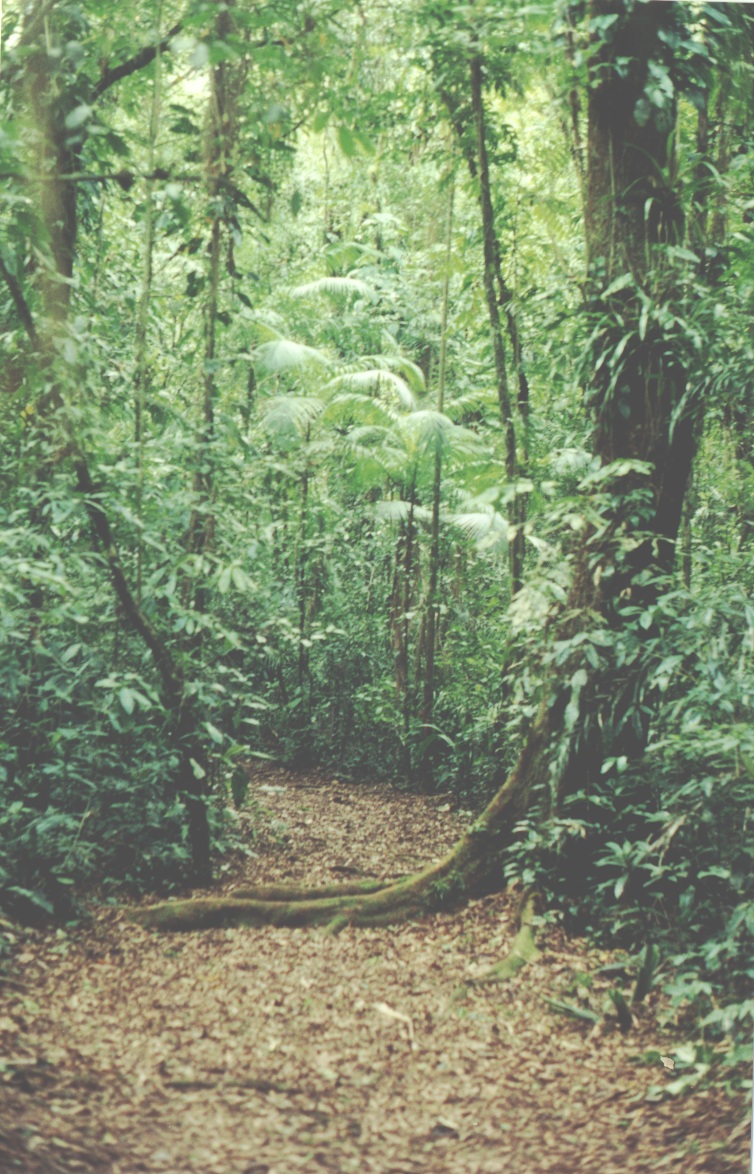
Corisco Trail, Picinguaba, near Ubatuba. Biome of Rhytipterna simplex. -
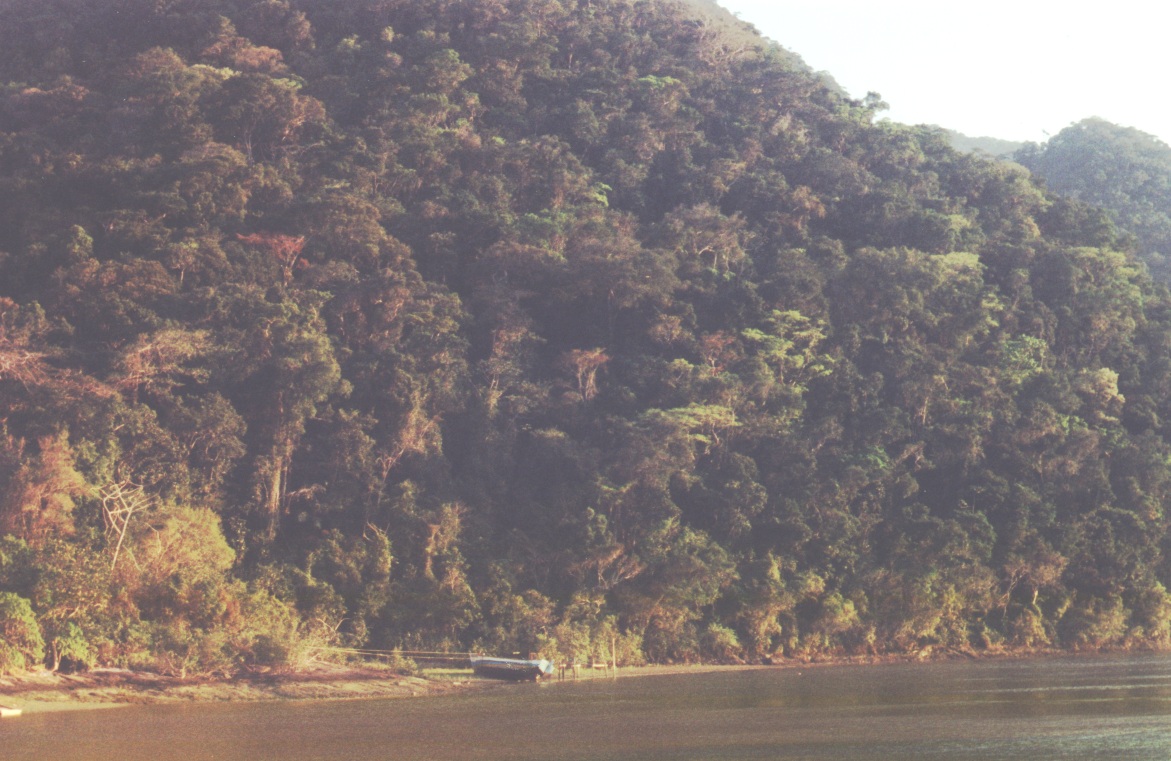
Jureia. Primary and secondary Atlantic rainforest along coast -
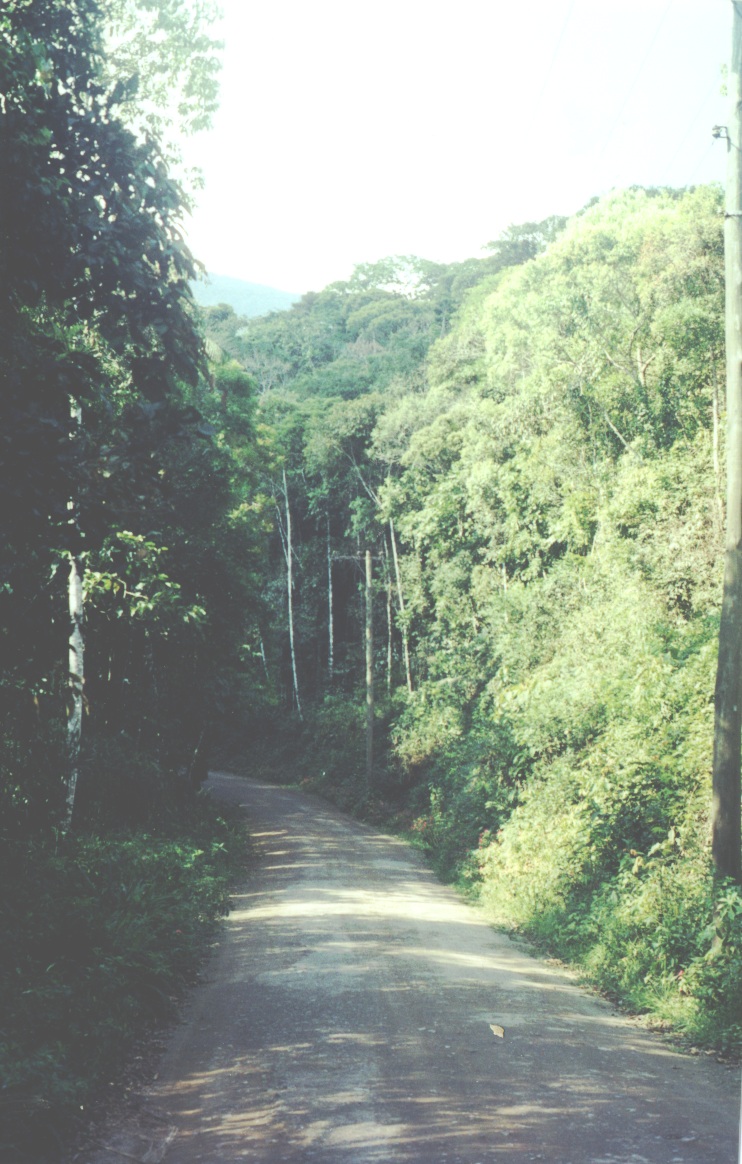
Itatiaia, below Hotel Do Ype. Biome of Phyllomyias burmeisteri. -
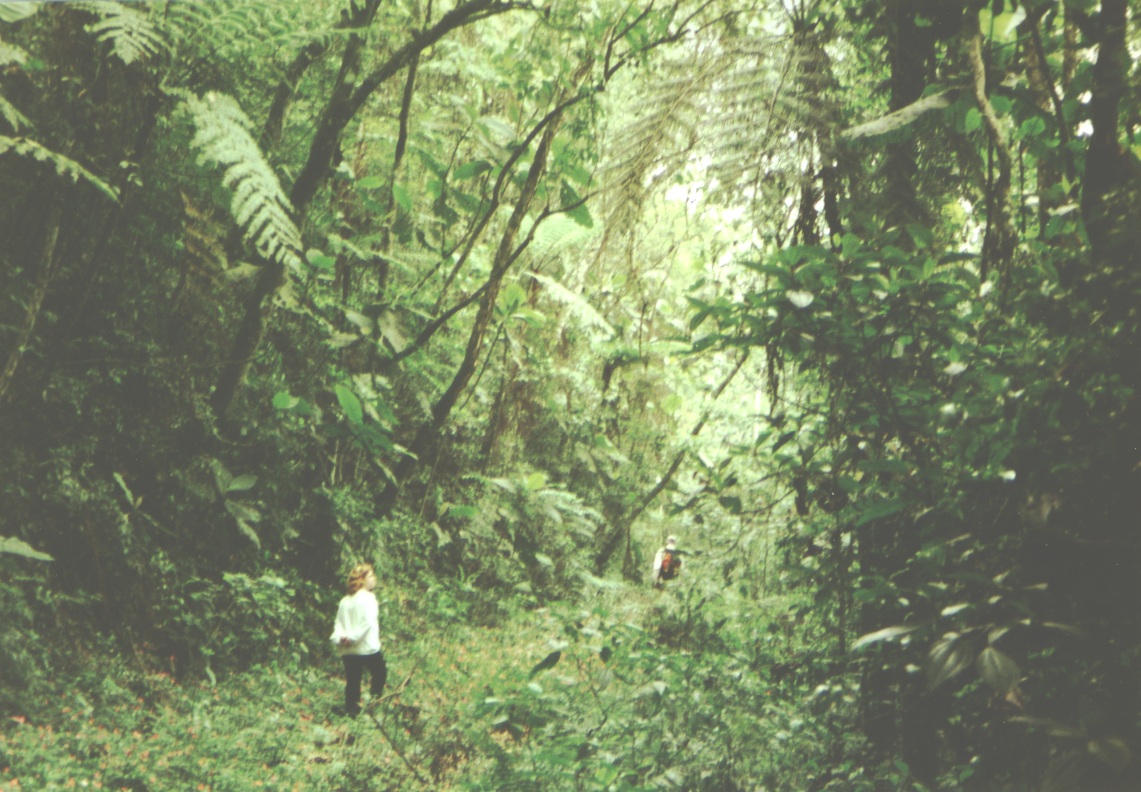
Dry secondary rainforest in the Serra da Cantareira. -
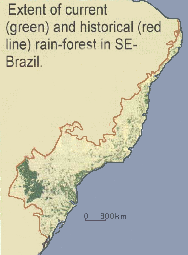
The extent of current and historical rainforest in eastern Brazil 25.
-
Merulaxis ater, song. Rio Escuro, near Ubatuba, 11/22/98. Sunny, 20°C. Secondary forest. With Myiodynastes maculatus, Vireo olivaceus, Thraupis cyanoptera.
-
Morning chorus at Fazenda Intervales 11/30/97. Sunny, 27°C. With Habia rubica, Chamaeza campanisoma, Chamaeza meruloides, Basileuterus culicivorus, Pyriglena leucoptera, Trogon viridis, Brotogeris tirica, Biatas nigropectus, Anabazenops fuscus, Grallaria varia, Cacicus haemorrhous, Trogon surrucura, Turdus rufiventris.
-
Biatas nigropectus. Fazenda Intervales, 11/29/97. Sunny, 27°C. Secondary forest. With Drymophila rubricollis, Turdus rufiventris, Carpornis cucullatus, Todirostrum plumbeiceps, Leptotila verreauxi, Cyclarhis gujanensis.
Where these come from
The work names each item by a file stem in its own caption records. The captions above are those records with the stem and its separators removed; where an item sat on the original page was not recorded and is not guessed.
- A78 original-cd/CD01/SEBrazil/PICTURE/A78.jpg
- A90 original-cd/CD01/SEBrazil/PICTURE/A90.JPG
- A68 original-cd/CD01/SEBrazil/PICTURE/A68.jpg
- A19 original-cd/CD01/SEBrazil/PICTURE/A19.jpg
- forest . original-cd/CD01/SEBrazil/PICTURE/forest.bmp
- 441002 original-cd/CD01/SEBrazil/WAV/441002.mp3
- Mc2 original-cd/CD01/SEBrazil/WAV/MC2.WAV
- 441004 original-cd/CD01/SEBrazil/WAV/441004.mp3
Works cited on this page
- 25. Brooks, T. 2000. Living on the edge. Nature 403:26-29.
Numbers are the work's own; they address the Disc 1 · 2011 bibliography.
This page on the other discs
Disc 2 · 2001
Vegetation 2 — Rainforests · page 7 of that disc
Rainforests
Wet littoral rainforest
This is the forest to which the term Atlantic Forest (Mata Atlantica) is usually applied. It is the dominant forest in the coastal lowlands up to an elevation of about 150 meters. Tree heights are generally in 10-15 meters range with emergent trees up to 20 meters. Species characteristic of this type of forest include Philydor atricapillus, Mionectes rufiventris, Ramphastos vitellinus, Attila rufus, Ramphodon naevius, Phylloscartes paulistus, Merulaxis ater (Song 1), Rhytipterna simplex etc.
The Atlantic Rainforest originally extended along the coast into Rio Grande do Sul and is at present found in a more or less degraded form near Parati, Ubatuba, Ilha São Sebastião, Bertioga, Santos, Peruibe, Iguape and on the Ilha do Cardoso. (Pics. 1,2)
Mountain rainforest.
This wet evergreen forest occurs along the coastal escarpment and in parts of the Serra da Mantiqueira and Serra de Paranapiacaba at elevations from about 150 meters to 800-1000 meters. Below 400 meters species of leguminous plants predominate. (Pic. 3, Song 2)
Bamboo.
Above 500 meters in the mountain rainforest there is often an abundance of bamboos of the genera Guadua and Merostachys which build dense thickets. The avifauna of the area includes several endemic bamboo specialists, some of which depend on the seeds of these grasses as a food source. These include Claravis godefrida, Haplospiza unicolor, Amaurospiza moesta, Sporophila frontalis and Sporophila falcirostris. Additional species typical of bamboo-dominated forest areas are Biatas nigropectus (Song 2 and 3), Psilorhamphus guttatus, Ramphotrigon megacephala and Hemitriccus diops.
Upland rainforest
Drier forest occurs on the inland slope of the mountains extending onto the Planato where precipitation, though reduced, still occurs in sufficient quantity in all months of the year to maintain an everygreen type forest. A remnant of this forest type still exists within the São Paulo City limits on the Serra Cantareira. A typical species of this region is Phylloscartes eximius (Pic. 4).
Semi-deciduous tropical forest.
In this type of forest there is a pronounced dry season. Though now largely gone in our area it was in fact the predominant type of forest cover in the area described in Pic. 5. Remnant forests still occur in areas such as Itirapina and Lencois with more extensive forests well out of the area to the west (e.g. Morro do Diabo). Typical species of this area are Phaeomyias murina, Serpophaga subcristata, and Elaenia chiriquensis.
Disc 3 · 2006
This disc carries the same wording as shown above.
Source details
- Release
- Disc 1 · 2011
- Recovered title
- Vegetation 2
- Recovered subtitle
- Rainforests
- Source location
- original-cd/CD01/SEBrazil/DOCS/Discussn.dat:record=7,offset=448; original-cd/CD01/SEBrazil/DOCS/Sebrazil.dfd:nul_segments=52-59
- Decoded text
- recovered-front-matter-release-aware-v0.1/releases/CD01/INTRODUCTION_TEXT/07.txt
- Page boundaries
- derived from the accepted CD03 boundaries by index-title correspondence plus mechanical segment-stream alignment (CD03 136 segments -> CD01 131 segments); closed by contiguity. This is a provisional sequence: the pages are numbered and titled exactly as the disc's own index records them, but the division of the running text into pages is inferred by this project from the ordered content. The original program's page-link bytes were never decoded, so this is the best-supported order available, not a proven reproduction of the original page flow.
- Text status
- Decoded from the preserved bytes: each byte is one CP1252 character, code point = byte + 31. The work's own markup (font and colour changes, line breaks, scientific-name markers, reference citations) is rendered rather than shown as codes. No spelling, punctuation or typography has been changed.
- Encoding record
- front-matter-encoding-recovery-v0.1