
Ornithology in Brazil 1
Early history
Early explorers
The first European to provide accurate data about birds in Brazil was the Calvinist missionary Jean de Léry (1534-1610). Lery lived among the Tupinambá Indians near the present Rio de Janeiro for years and gave valuable accounts of the birds known to the Indians. In the seventeenth century Father Claude d'Abbeville and Frei Cristovao de Lisboa published histories of the Maranão Island that included the animals and trees of that area and at the same time the German naturalist Georg Marcgrave organized the first expedition on Brazilian soil. Marcgrave's excellent Historia Naturalis Brasiliae was published in 1648. In the eighteenth century the military engineer Amedee Francois Frézier visited Santa Catarina and made ornithological observations and Alexandre Rodrigues Ferreira collected in Mato Grosso and southern Amazonia. Ferreira's work resulted in the first collected material that went to Museums in Europe.
The nineteenth century
After that of Ferreira, the second scientific bird collection to reach Europe (especially the Berlin Museum) was that of Luis Beltrão and F. A. Gomes of Rio de Janeiro and F. W. Sieber of Pará. Sieber is the discoverer of Tinamus tao, Crypturellus strigulosus, Rostrhamus hamatus and Pionopsitta vulturina. In 1813 Georg H. von Langsdorff came to Rio de Janeiro and became an important figure in Brazilian ornithology. He later brought G. W. Freyreiss (who described Laniisoma elegans), F. Sellow (who found Anodorhynchus glaucus in Rio Grande do Sul and Mergus octosetaceus) and E. Ménétriès (who described Scytalopus speluncae and Psilorhamphus guttatus). In 1815 Prince Maximilian von Wied Neuwied also came to Rio de Janeiro. and for three years studied the fauna from Rio to Bahia and filled four volumes of the Contributions to Natural History of Brazil with his studies. In 1816 William Swainson came to Pernambuco and Bahia to collect animals and Charles Waterton collected in Pernambuco and Maranhão.
Certainly two of the most important naturalists working in Brazil at this time were the zoologists Johannes Natterer and Johann Baptist von Spix who accompanied Princess Leopoldina of Austria on her voyage to Brazil in 1817. The ensuing Natterer collection contained 12300 stuffed birds of 1200 species. Natterer also noted many characteristics concerning behaviour and distribution while Spix found various species including six species of Curassows, e.g. Penelope jacquacu, Penelope jacucaca, Ortalis guttata, Pipile jacutinga, Nothocrax urumutum, and Mitu tuberosa.
In the middle of the century notable work was done by Dr. Hermann Burmeister who visited Brazil in 1850 for two years and Jean T. Descourtilz who, in 1851, began the study of such rarities as Calyptura cristata. Fritz Müller came to Santa Catarina in 1852. He was particularly interested in insects and plants, but he also studied hummingbirds. In 1853 Karl Hieronymus Euler came from Switzerland to Brazil, where he studied mostly breeding behavior of birds. Later, Herrman von Ihering settled in Rio Grande do Sul in 1880 as a medical doctor and naturalist. He was director of the Museu Paulista for 22 years and is a towering name in Brazilian ornithology as is Emil A Goeldi who came to Brazil from Jena, Germany and who is known for the reorganization of the Para Museum of Natural History and Ethnography, which today bears his name, and for his studies in Amazonia.
Images and recordings on this page
-
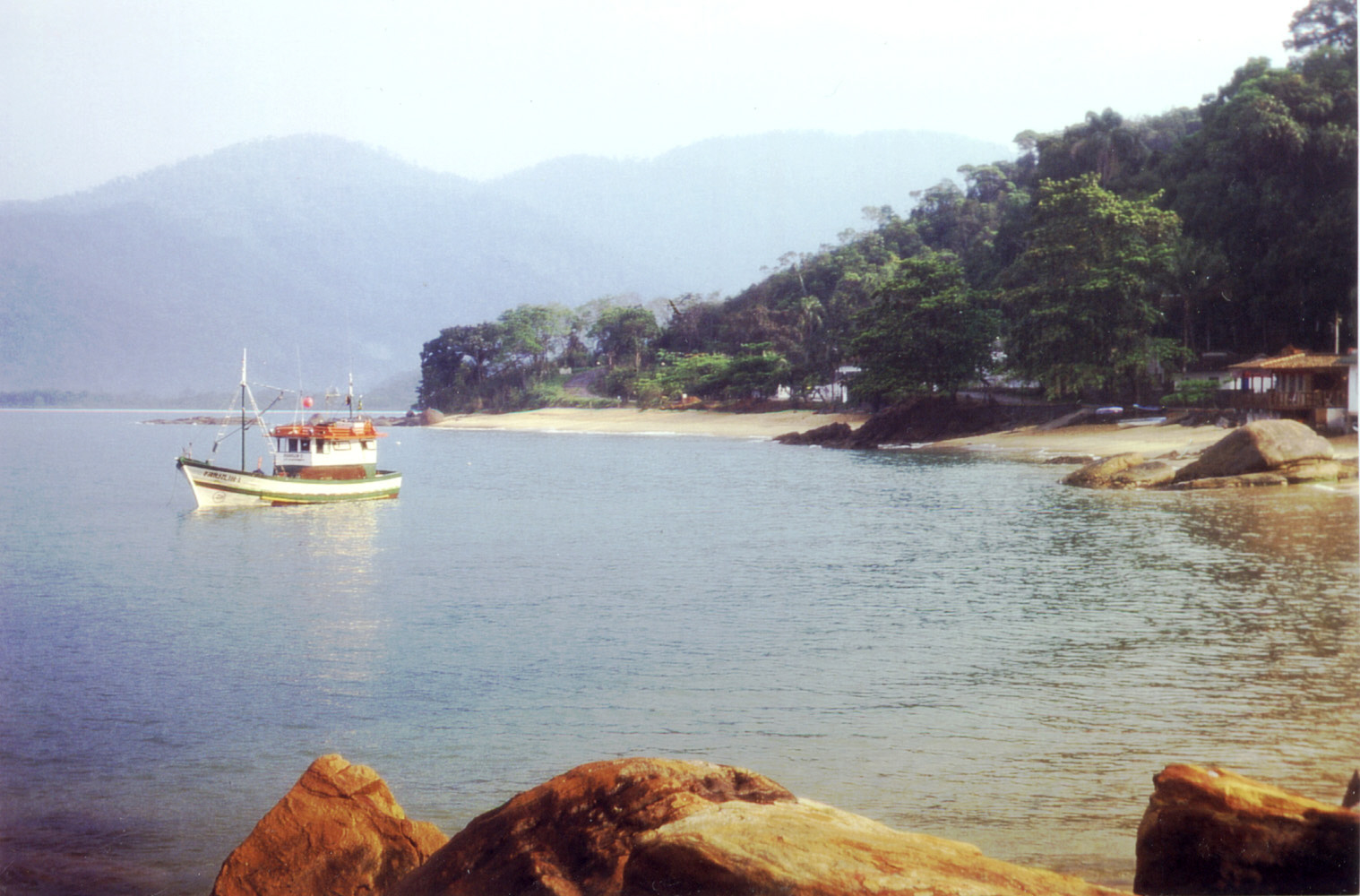
Picinguaba. The coast east of Ubatuba
-
Saltator similis, Picinguaba, east of Ubatuba, 10/15/99. Sunny, 27°C. Forest border. With Dysithamnus stictothorax, Brotogeris tirica, Myiodynastes maculatus, Myiozetetes similis, Phacellodomus erythropthalmus, Galbula ruficauda.
Where these come from
The work names each item by a file stem in its own caption records. The captions above are those records with the stem and its separators removed; where an item sat on the original page was not recorded and is not guessed.
- Ub_2 original-cd/CD01/SEBrazil/PICTURE/Ub_2.jpg — resolved from the caption record
- 441005 original-cd/CD01/SEBrazil/WAV/441005.mp3
This page on the other discs
Disc 2 · 2001
Ornithology in Brazil 1 — Early history · page 11 of that disc
Early explorers
The first European to provide accurate data about birds in Brazil was the Calvinist missionary Jean de Léry (1534-1610). Lery lived among the Tupinambá Indians near the present Rio de Janeiro for years and gave valuable accounts of the birds known to the Indians. In the seventeenth century Father Claude d'Abbeville and Frei Cristovão de Lisboa published histories of the Maranão Island that included the animals and trees of that area and at the same time the German naturalist Georg Marcgrave organized the first expedition on Brazilian soil. Marcgrave's excellent Historia Naturalis Brasiliae was published in 1648. In the eighteenth century the military engineer Amedee Francois Frézier visited Santa Catarina and made ornithological observations and Alexandre Rodrigues Ferreira collected in Mato Grosso and southern Amazonia. Ferreira's work resulted in the first collected material that went to Museums in Europe.
The nineteenth century
After that of Ferreira, the second scientific bird collection to reach Europe (especially the Berlin Museum) was that of Luis Beltrão and F. A. Gomes of Rio de Janeiro and F. W. Sieber of Pará. Sieber is the discoverer of Tinamus tao, Crypturellus strigulosus, Rostrhamus hamatus and Pionopsitta vulturina. In 1813 Georg H. von Langsdorff came to Rio de Janeiro and became an important figure in Brazilian ornithology. He later brought G. W. Freyreiss (who described Laniisoma elegans), F. Sellow (who found Anodorhynchus glaucus in Rio Grande do Sul and Mergus octosetaceus) and E. Ménétriès (who described Scytalopus speluncae and Psilorhamphus guttatus). In 1815 Prince Maximilian von Wied Neuwied also came to Rio de Janeiro. and for three years studied the fauna from Rio to Bahia and filled four volumes of the Contributions to Natural History of Brazil with his studies. In 1816 William Swainson came to Pernambuco and Bahia to collect animals and Charles Waterton collected in Pernambuco and Maranhão.
Certainly two of the most important naturalists working in Brazil at this time were the zoologists Johannes Natterer and Johann Baptist von Spix who accompanied Princess Leopoldina of Austria on her voyage to Brazil in 1817. The ensuing Natterer collection contained 12300 stuffed birds of 1200 species. Natterer also noted many characteristics concerning behaviour and distribution while Spix found various species including six species of Curassows, e.g. Penelope jacquacu, Penelope jacucaca, Ortalis guttata, Pipile jacutinga, Nothocrax urumutum, and Mitu tuberosa.
In the middle of the century notable work was done by Dr. Hermann Burmeister who visited Brazil in 1850 for two years and Jean T. Descourtilz who, in 1851, began the study of such rarities as Calyptura cristata. Fritz Müller came to Santa Catarina in 1852. He was particularly interested in insects and plants, but he also studied hummingbirds. In 1853 Karl Hieronymus Euler came from Switzerland to Brazil, where he studied mostly breeding behavior of birds. Later, Herrman von Ihering settled in Rio Grande do Sul in 1880 as a medical doctor and naturalist. He was director of the Museu Paulista for 22 years and is a towering name in Brazilian ornithology as is Emil A Goeldi who came to Brazil from Jena, Germany and who is known for the reorganization of the Para Museum of Natural History and Ethnography, which today bears his name, and for his studies in Amazonia.
(Shortened after 30)
Disc 3 · 2006
This disc carries the same wording as shown above.
Source details
- Release
- Disc 1 · 2011
- Recovered title
- Ornithology in Brazil 1
- Recovered subtitle
- Early history
- Source location
- original-cd/CD01/SEBrazil/DOCS/Discussn.dat:record=11,offset=704; original-cd/CD01/SEBrazil/DOCS/Sebrazil.dfd:nul_segments=78-83
- Decoded text
- recovered-front-matter-release-aware-v0.1/releases/CD01/INTRODUCTION_TEXT/11.txt
- Page boundaries
- derived from the accepted CD03 boundaries by index-title correspondence plus mechanical segment-stream alignment (CD03 136 segments -> CD01 131 segments); closed by contiguity. This is a provisional sequence: the pages are numbered and titled exactly as the disc's own index records them, but the division of the running text into pages is inferred by this project from the ordered content. The original program's page-link bytes were never decoded, so this is the best-supported order available, not a proven reproduction of the original page flow.
- Text status
- Decoded from the preserved bytes: each byte is one CP1252 character, code point = byte + 31. The work's own markup (font and colour changes, line breaks, scientific-name markers, reference citations) is rendered rather than shown as codes. No spelling, punctuation or typography has been changed.
- Encoding record
- front-matter-encoding-recovery-v0.1