Acknowledgments
I am very grateful to Greg Budney, Curator, Laboratory of Natural Sounds, Cornell University, Ithaca, 159 Sapsucker Woods Road, Ithaca, NY 14850 for allowing me to use numerous recordings from the collection of the Laboratory of Natural Sounds. I am also indebted to Mrs. Andrea Priori, Carol Bloomgarden and Martha Fisher, of the Laboratory of Natural Sounds, who spent numerous hours of their valuable time to copy hundreds of vocalizations from the Library.
Thanks also to Paulo Boute, Edson Endrigo, Jeremy Minns and Luis Fabio Silveira, all from São Paulo, Brazil, and Juan Mazar Barnett, Argentina and Guy Kirwan, Great Britain, for making recorded vocalizations available for inclusion in this program and to Edson Endrigo and Dr. Karl Friedrich Müller, New York, for permission to use some of their excellent photographs.
For their accompaniment on my numerous field trips to the region thanks also to Mario Barroso Ramos Neto, São Paulo; Dr. Karl Friedrich Müller, New York; Dr. Edwin O. Willis, Departamento de Zoologia, Universidade Estadual de São Paulo, Rio Claro (SP); Luis Avelino Ribeiro, Fazenda Intervales; and Pedro Develey, São Paulo; I am also very grateful to Professors Dr. Tereza Kipnis and Dr. Dias da Silva for their generous hospitality which allowed me to stay at their houses in São Paulo and Ubatuba (SP), and to Acacio Senior and Gloria de Barros for their generous hospitality that made it possible to stay at their house in Petropolis (RJ).
Over the years I have received much help and suggestions from Dr. Raymond Paynter, Curator at the Museum of Comparative Zoology, Harvard University, Cambridge, MA. and I would also like to thank Dr. Paynter for allowing me access to the bird collection of the Museum of Comparative Zoology at Cambridge to study the skins and for the use of his extensive personal library on South American ornithology.
I would also offer additional thanks to Prof. Dr. Edwin O. Willis, Rio Claro who was an indispensable source of information concerning the birds of Estado São Paulo.
Finally thanks go to Dr. David Gibson of GG Software who designed and wrote the software used to display this work and provided much additional editing help and advice.
Images and recordings on this page
-
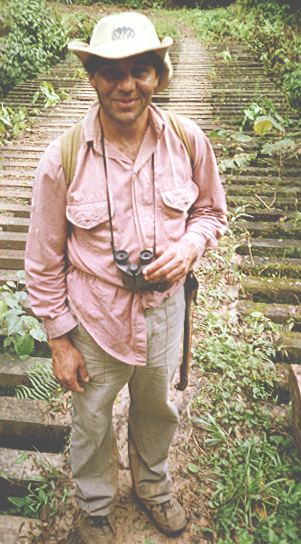
Luiz Avelino Ribeiro. A ranger at Fazenda Intervales State Park who knows more field biology than many a tour leader. -
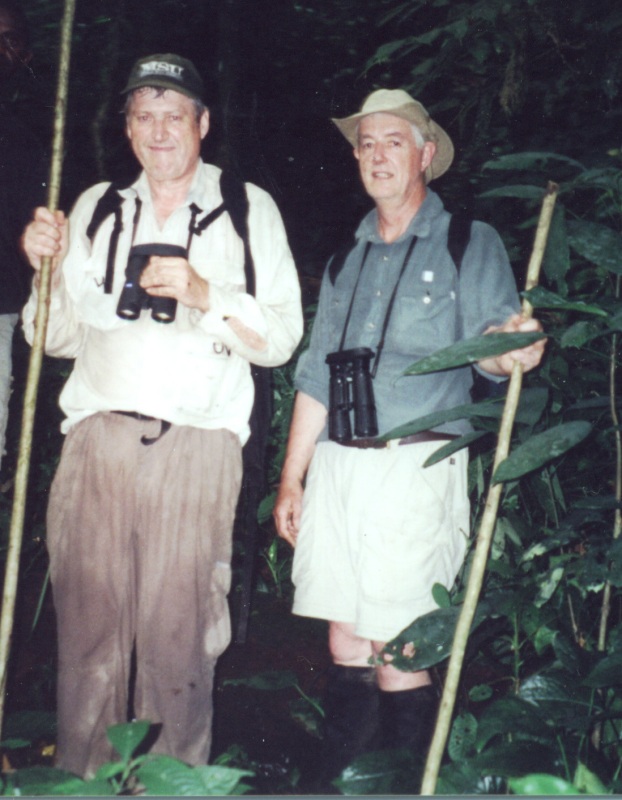
The author & David Gibson in Cameroon.
-
Polystictus pectoralis, Itirapina, 11/12/95. Sunny, 30°C. Open cerrado with low scrub.
Where these come from
The work names each item by a file stem in its own caption records. The captions above are those records with the stem and its separators removed; where an item sat on the original page was not recorded and is not guessed.
- 1Intrv1 original-cd/CD01/SEBrazil/PICTURE/1Intrv1.jpg
- HD !. original-cd/CD01/SEBrazil/PICTURE/HD.jpg
- 441008 original-cd/CD01/SEBrazil/WAV/441008.mp3
This page on the other discs
Disc 2 · 2001
Acknowledgments · page 13 of that disc
I am very grateful to Greg Budney, Curator, Laboratory of Natural Sounds, Cornell University, Ithaca, 159 Sapsucker Woods Road, Ithaca, NY 14850 for allowing me to use numerous recordings from the collection of the Laboratory of Natural Sounds. I am also indebted to Mrs. Andrea Priori, Carol Bloomgarden and Martha Fisher, of the Laboratory of Natural Sounds, who spent numerous hours of their valuable time to copy hundreds of vocalizations from the Library.
Thanks also to Paulo Boute, Edson Endrigo, Jeremy Minns and Luis Fabio Silveira, all from São Paulo, Brazil, and Juan Mazar Barnett, Argentina and Guy Kirwan, Great Britain, for making recorded vocalizations available for inclusion in this program and to Edson Endrigo and Dr. Karl Friedrich Müller, New York, for permission to use some of their excellent photographs.
For their accompaniment on my numerous field trips to the region thanks also to Mario Barroso Ramos Neto, São Paulo; Dr. Karl Friedrich Müller, New York; Dr. Edwin O. Willis, Departamento de Zoologia, Universidade Estadual de São Paulo, Rio Claro (SP); Luis Avelino Ribeiro, Fazenda Intervales; and Pedro Develey, São Paulo; I am also very grateful to Professors Dr. Tereza Kipnis and Dr. Dias da Silva for their generous hospitality which allowed me to stay at their houses in São Paulo and Ubatuba (SP), and to Acacio Senior and Gloria de Barros for their generous hospitality that made it possible to stay at their house in Petropolis (RJ).
Over the years I have received much help and suggestions from Dr. Raymond Paynter, Curator at the Museum of Comparative Zoology, Harvard University, Cambridge, MA. and I would also like to thank Dr. Paynter for allowing me access to the bird collection of the Museum of Comparative Zoology at Cambridge to study the skins and for the use of his extensive personal library on South American ornithology.
I would also offer additional thanks to Prof. Dr. Edwin O. Willis, Rio Claro who was an indispensable source of information concerning the birds of Estado São Paulo.
Finally thanks go to Dr. David Gibson of GG Software who designed and wrote the software used to display this work and provided much additional editing help and advice.
Disc 3 · 2006
This disc carries the same wording as shown above.
Source details
- Release
- Disc 1 · 2011
- Recovered title
- Acknowledgments
- Source location
- original-cd/CD01/SEBrazil/DOCS/Discussn.dat:record=13,offset=832; original-cd/CD01/SEBrazil/DOCS/Sebrazil.dfd:nul_segments=91-98
- Decoded text
- recovered-front-matter-release-aware-v0.1/releases/CD01/INTRODUCTION_TEXT/13.txt
- Page boundaries
- derived from the accepted CD03 boundaries by index-title correspondence plus mechanical segment-stream alignment (CD03 136 segments -> CD01 131 segments); closed by contiguity. This is a provisional sequence: the pages are numbered and titled exactly as the disc's own index records them, but the division of the running text into pages is inferred by this project from the ordered content. The original program's page-link bytes were never decoded, so this is the best-supported order available, not a proven reproduction of the original page flow.
- Text status
- Decoded from the preserved bytes: each byte is one CP1252 character, code point = byte + 31. The work's own markup (font and colour changes, line breaks, scientific-name markers, reference citations) is rendered rather than shown as codes. No spelling, punctuation or typography has been changed.
- Encoding record
- front-matter-encoding-recovery-v0.1