Conservation 2
A biodiversity hotspot
A Biodiversity Hotspot.
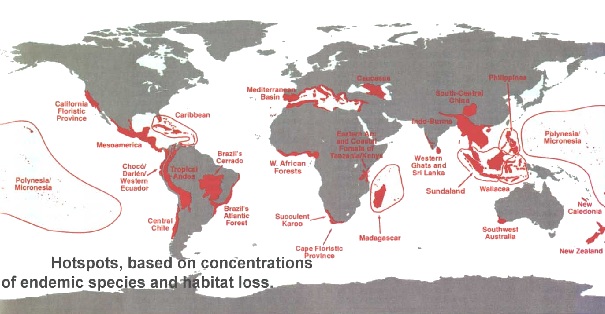
Fortunately it has been recognized that the Atlantic rainforest is an exceptionally rich biodiversity hotspot 26. 'Hotspots' are characterized by their particularly high concentration of endemic species (Pic. 2). Forty four percent of all vascular plants and 35 % of all species in four vertebrate groups are confined to 25 hotspots comprising only 1.4% of the land surface of the earth 27. The Atlantic rainforest belongs to an exceptionally rich group of hyper-hot hotspots including the Andes, the Caribbean, Madagascar and the Greater Sundas, which contains only 0.4% of the Earth's land surface, but at least 2% of all species world wide and 16% of all vertebrates.
Recent Conservation efforts.
To preserve this richness, more recent conservation efforts have focused on the creation of larger corridors of conserved areas and thus larger habitat tracts able to sustain viable populations of large fruit-eating mammals (Agoutis, primates) and birds (Curassows, Toucans, Trogons, large Cotingas) involved in fruit dispersal.
The 'Reserva da Biosfera da Mata Atlantica'
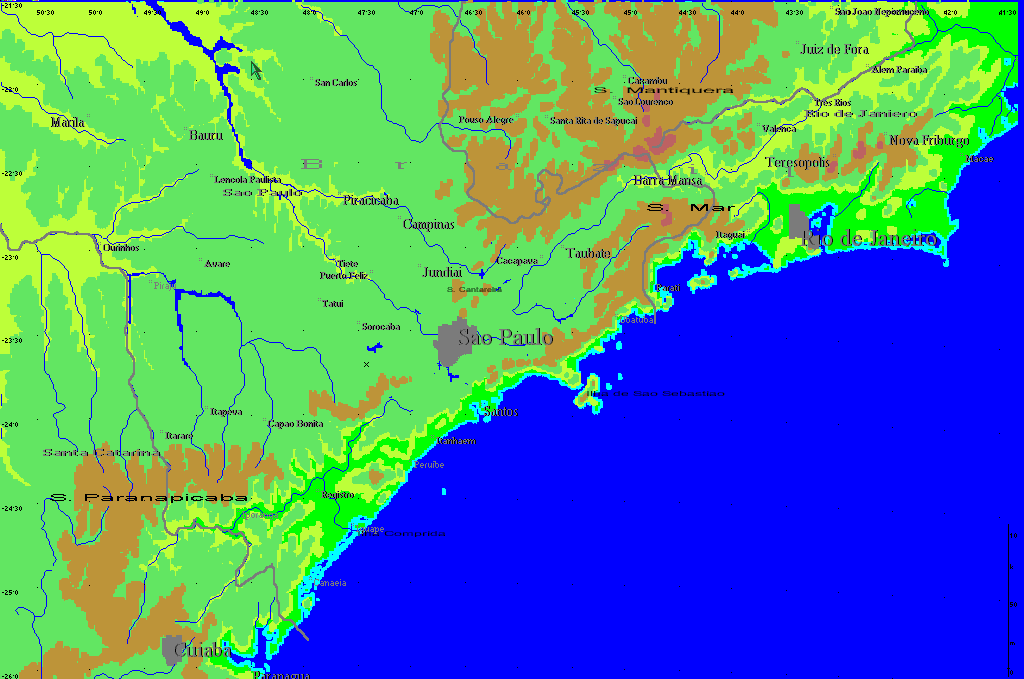
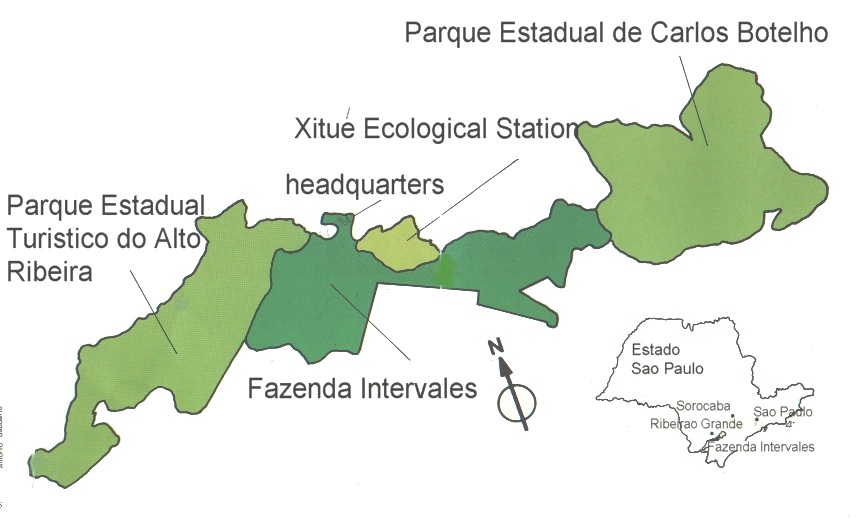
has been established by the State of São Paulo. The reserve consists of a series of contiguous state parks (Parque Estadual Turistico do Alto Ribeira, Fazenda Intervales, Saibadela, and Parque National de Carlos Botelho - see Pic. 3) in the Serra Paranapiacaba. In the Serra do Mar a strip of continuous forest (albeit degraded at places) much of which is in the Parque Estadual do Serra do Mar, is found from Angra dos Reis to Santos. From Peruibe southwards, a mostly conserved area extends along the coast and includes the Parque Estadual de Pariqueira-Abaixo, Jureia and the Parque Estadual da Ilho do Cardoso.
Images and recordings on this page
-
The disc stores no caption for this picture. -
Area Map -
PN Carlos Botelho and surrounding parks
-
Penelope obscura, Fazenda Intervales, 11/29/98. Sunny, 27°C. Primary forest. With Pyriglena leucoptera, Campylorhamphus falcularius.
Where these come from
The work names each item by a file stem in its own caption records. The captions above are those records with the stem and its separators removed; where an item sat on the original page was not recorded and is not guessed.
- hotspot original-cd/CD01/SEBrazil/PICTURE/Hotspot.jpg
- c05da526 original-cd/CD01/SEBrazil/PICTURE/C05DA526.BMP
- PEST1 . original-cd/CD01/SEBrazil/PICTURE/PEST1.jpg
- 441010 original-cd/CD01/SEBrazil/WAV/441010.wav
Works cited on this page
- 26. Myers, N., 1990. The biodiversity challenge: expanded hotspots analysis. Environmentalist 10: 243-256.
- 27. Myers, N, Mittermeier R.A., Mittermeier C.G., da Fonseca G.A.B., Kent J., 2000. Biodiversity hotspots for conservation priorities. Nature 403: 853-858.
Numbers are the work's own; they address the Disc 1 · 2011 bibliography.
This page on the other discs
Disc 2 · 2001
Conservation 2 — A biodiversity hotspot · page 10 of that disc
A Biodiversity Hotspot.
Fortunately it has been recognized that the Atlantic rainforest is an exceptionally rich biodiversity hotspot 26. 'Hotspots' are characterized by their particularly high concentration of endemic species (Pic. 1). Forty four percent of all vascular plants and 35 % of all species in four vertebrate groups are confined to 25 hotspots comprising only 1.4% of the land surface of the earth 27. The Atlantic rainforest belongs to an exceptionally rich group of hyper-hot hotspots including the Andes, the Caribbean, Madagascar and the Greater Sundas, which contains only 0.4% of the Earth's land surface, but at least 2% of all species world wide and 16% of all vertebrates.
Recent Conservation efforts.
To preserve this richness, more recent conservation efforts have focused on the creation of larger corridors of conserved areas and thus larger habitat tracts able to sustain viable populations of large fruit-eating mammals (Agoutis, primates) and birds (Curassows, Toucans, Trogons, large Cotingas) involved in fruit dispersal.
The 'Reserva da Biosfera da Mata Atlantica'
has been established by the State of São Paulo. The reserve consists of a series of contiguous state parks (Parque Estadual Turistico do Alto Ribeira, Fazenda Intervales, Saibadela, and Parque National de Carlos Botelho - see Pic. 3) in the Serra Paranapiacaba. In the Serra do Mar a strip of continuous forest (albeit degraded at places) much of which is in the Parque Estadual do Serra do Mar, is found from Angra dos Reis to Santos. From Peruibe southwards, a mostly conserved area extends along the coast and includes the Parque Estadual de Pariqueira-Abaixo, Jureia and the Parque Estadual da Ilho do Cardoso.
Disc 3 · 2006
This disc carries the same wording as shown above.
Source details
- Release
- Disc 1 · 2011
- Recovered title
- Conservation 2
- Recovered subtitle
- A biodiversity hotspot
- Source location
- original-cd/CD01/SEBrazil/DOCS/Discussn.dat:record=10,offset=640; original-cd/CD01/SEBrazil/DOCS/Sebrazil.dfd:nul_segments=72-77
- Decoded text
- recovered-front-matter-release-aware-v0.1/releases/CD01/INTRODUCTION_TEXT/10.txt
- Page boundaries
- derived from the accepted CD03 boundaries by index-title correspondence plus mechanical segment-stream alignment (CD03 136 segments -> CD01 131 segments); closed by contiguity. This is a provisional sequence: the pages are numbered and titled exactly as the disc's own index records them, but the division of the running text into pages is inferred by this project from the ordered content. The original program's page-link bytes were never decoded, so this is the best-supported order available, not a proven reproduction of the original page flow.
- Text status
- Decoded from the preserved bytes: each byte is one CP1252 character, code point = byte + 31. The work's own markup (font and colour changes, line breaks, scientific-name markers, reference citations) is rendered rather than shown as codes. No spelling, punctuation or typography has been changed.
- Encoding record
- front-matter-encoding-recovery-v0.1