The concept of the work
A Field Guide
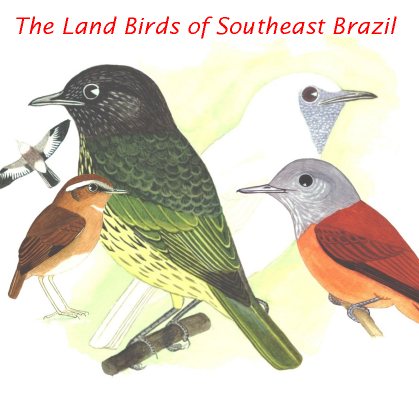
Despite the far greater amount of information that can be conveyed using modern computer techniques, the transfer of current print field guides into electronic form has been slow. This current work is an attempt to change that situation. It incorporates all the information that would normally be included in a print field guide: a full description, a high quality pictorial representation of each species and a map indicating species distribution within the target area - with a comprehensive set of vocalizations for most species (the exceptions are for those species whose vocalizations are not known or, if they exist have never been recorded or the recordings are at present not accessible).
Other enhancements over print media include the ability to display the pictorial representation of many species - even those somewhat larger than your typical computer screen - at their actual life size; to display the distributional information for an individual species based on actual records of occurence (checklists) and to readily access such checklists to summarize the species occuring at a number of different locations. (Although barely exploited in this edition, the ability to include video records of species behaviour is also an integral part of this technique).
For an individual species all information is presented in concise form in a single computer window, or page. These pages can be resized and many different pages can be displayed simultaneously, an ability which makes comparison of information for different species easy: depending upon available system memory up to 100 pages could be open at any one time. We hope that this guide will also aid in conservation efforts which are so necessary to preserve of what is left of the Southeast Brazilian biomes.
The Land Birds of Southeast Brazil.
The area of southeastern Brazil dealt with in this guide is unique in many respects. Virtually surrounding one of the larger population centers in the world remain large tracts of tropical and subtropical forests in considerable variety. The diversity and uniqueness of the location: just within the tropics, adjacent to and in a favourable position to receive large quantities of moisture from the Atlantic Ocean, with a complex mountainous terrain yet nowhere subject to frosts have resulted in a high level of unique and endemic species. The area has been identified as one of the world's major biodiversity 'hotspots'. And yet, it has been, until this point, about the only remaining area of the world with a high level of endemic species and without a printed field guide to the area.
Once all discs of this series are published this situation will be fully rectified. Over 650 species, including all endemic species, and indeed, including some which have been sighted only rarely in the past 100 years, are fully described, the great majority with vocalizations and distribution maps based on actual location checklists.
Images and recordings on this page
-
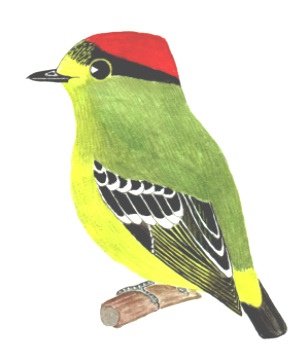
Calyptura cristata
-
12/1/97. Sunny, 27°C. An early morning cut from the Barra Grande road, Fazenda Intervales, SP, with: Pyriglena leucoptera, Saltator similis, Vireo olivaceus, Stephanophorus diadematus, Carpornis cucullatus, Thamnophilus caerulescens, Basileuterus culicivorus, Attila rufus, Drymophila ochropyga etc.
Where these come from
The work names each item by a file stem in its own caption records. The captions above are those records with the stem and its separators removed; where an item sat on the original page was not recorded and is not guessed.
- clptcrs1 ^ original-cd/CD01/SEBrazil/PICTURE/clptcrs1.jpg
- Mc1 original-cd/CD01/SEBrazil/WAV/MC1.mp3
This page on the other discs
Disc 2 · 2001
This disc carries the same wording as shown above.
Disc 3 · 2006
This disc carries the same wording as shown above.
Source details
- Release
- Disc 1 · 2011
- Recovered title
- The concept of the work
- Source location
- original-cd/CD01/SEBrazil/DOCS/Discussn.dat:record=1,offset=64; original-cd/CD01/SEBrazil/DOCS/Sebrazil.dfd:nul_segments=1-8
- Decoded text
- recovered-front-matter-release-aware-v0.1/releases/CD01/INTRODUCTION_TEXT/01.txt
- Page boundaries
- derived from the accepted CD03 boundaries by index-title correspondence plus mechanical segment-stream alignment (CD03 136 segments -> CD01 131 segments); closed by contiguity. This is a provisional sequence: the pages are numbered and titled exactly as the disc's own index records them, but the division of the running text into pages is inferred by this project from the ordered content. The original program's page-link bytes were never decoded, so this is the best-supported order available, not a proven reproduction of the original page flow.
- Text status
- Decoded from the preserved bytes: each byte is one CP1252 character, code point = byte + 31. The work's own markup (font and colour changes, line breaks, scientific-name markers, reference citations) is rendered rather than shown as codes. No spelling, punctuation or typography has been changed.
- Encoding record
- front-matter-encoding-recovery-v0.1