Area Covered
The Land Birds of Southeast Brazil deals principally with the southern portion of that area of eastern Brazil that is (or was) originally covered by humid Atlantic tropical and related sub-tropical forests at higher elevations. Such forests occur only along the immediate Atlantic coast of Brazil and are further unusual in extending a considerable distance south of the Tropic of Capricorn while retaining their tropical nature. Inland, however they extend for less than 100 kilometers or so before they are replaced by (what was originally) drier semi-deciduous forests, with areas of cerradão to the north and cerrado and also aruacaria or coniferous forests to the west.
Practically, this area is centered on the city of São Paulo, extending from that city 300-400 kilometers to Rio de Janeiro in the east, Curitiba in the south and north to approximately 22° South latitude, covering the following specific geographic features:
1.
The coastal littoral.
2.
The coastal mountains of the Serra do Mar which extend in some cases on to coastal islands such as the Ilha São Sebastião.
3.
Intermontane valleys, principally of the Ribeira river and the upper valley of the River Paraiba.
4.
The inland mountains of the Serra de Paranapiacaba, the Serra da Mantiqueira and the Serra dos Orgãos,
5.
Adjacent portions of the Parana Altiplano in the upper drainage of the rivers Parapanema and Tiete.
Areas beyond these limits may also be covered by checklists intended to illustrate specific distribution ranges. Species that occur only in extralimital areas and do not extend into the area of coverage are included if they might be encountered as vagrants. As may be gathered from the title coastal marine and pelagic habitats are excluded.
Images and recordings on this page
-
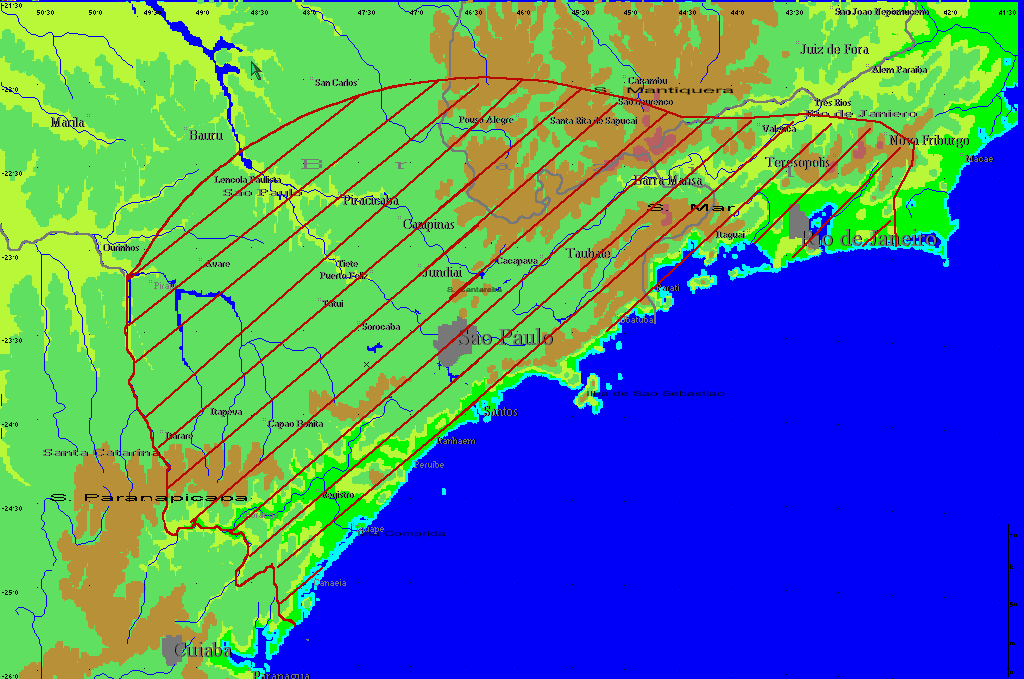
Area Map. Red shaded area shows prinicpal area covered.
-
Morning chorus. 11/20/98 Pisinguaba, east of Ubatuba. Cloudy, 20°C. Secondary forest. With Tachyphonus coronatus, Parula pitiayumi, Turdus rufiventris, Pyriglena leucoptera, Drymophila ferruginea, Trogon viridis, Galbula ruficauda, Thryothorus longirostris, Saltator fuliginosus, Basileuterus rivularis.
Where these come from
The work names each item by a file stem in its own caption records. The captions above are those records with the stem and its separators removed; where an item sat on the original page was not recorded and is not guessed.
- Areacov original-cd/CD01/SEBrazil/PICTURE/Areacov.bmp
- Mc4 original-cd/CD01/SEBrazil/WAV/MC4.mp3
This page on the other discs
Disc 2 · 2001
Area Covered · page 3 of that disc
The Land Birds of Southeast Brazil deals principally with the southern portion of that area of eastern Brazil that is (or was) originally covered by humid Atlantic tropical and related sub-tropical forests at higher elevations. Such forests occur only along the immediate Atlantic coast of Brazil and are further unusual in extending a considerable distance south of the Tropic of Capricorn while retaining their tropical nature. Inland, however they extend for less than 100 kilometers or so before they are replaced by (what was originally) drier semi-deciduous forests, with areas of cerradão to the north and cerrado and also aruacaria or coniferous forests to the west.
Practically, this area is centered on the city of São Paulo, extending from that city 300-400 kilometers to Rio de Janeiro in the east, Curitiba in the south and north to approximately 22° South latitude, covering the following specific geographic features:
1.
The coastal littoral.
2.
The coastal mountains of the Serra do Mar which extend in some cases on to coastal islands such as the Ilha São Sebastião.
3.
Intermontane valleys, principally of the Ribeira river and the upper valley of the River Paraiba.
4.
The inland mountains of the Serra de Paranapiacaba, the Serra da Mantiqueira and the Serra dos Orgãos,
5.
Adjacent portions of the Parana Altiplano in the upper drainage of the rivers Parapanema and Tiete.
Areas beyond these limits may also be covered by checklists intended to illustrate specific distribution ranges but species that occur only in extralimital areas and do not extend into the area of coverage are not included. As may be gathered from the title coastal marine and pelagic habitats are excluded.
Disc 3 · 2006
This disc carries the same wording as shown above.
Source details
- Release
- Disc 1 · 2011
- Recovered title
- Area Covered
- Source location
- original-cd/CD01/SEBrazil/DOCS/Discussn.dat:record=3,offset=192; original-cd/CD01/SEBrazil/DOCS/Sebrazil.dfd:nul_segments=18-26
- Decoded text
- recovered-front-matter-release-aware-v0.1/releases/CD01/INTRODUCTION_TEXT/03.txt
- Page boundaries
- derived from the accepted CD03 boundaries by index-title correspondence plus mechanical segment-stream alignment (CD03 136 segments -> CD01 131 segments); closed by contiguity. This is a provisional sequence: the pages are numbered and titled exactly as the disc's own index records them, but the division of the running text into pages is inferred by this project from the ordered content. The original program's page-link bytes were never decoded, so this is the best-supported order available, not a proven reproduction of the original page flow.
- Text status
- Decoded from the preserved bytes: each byte is one CP1252 character, code point = byte + 31. The work's own markup (font and colour changes, line breaks, scientific-name markers, reference citations) is rendered rather than shown as codes. No spelling, punctuation or typography has been changed.
- Encoding record
- front-matter-encoding-recovery-v0.1