The Species
and causes of diversity
Species covered
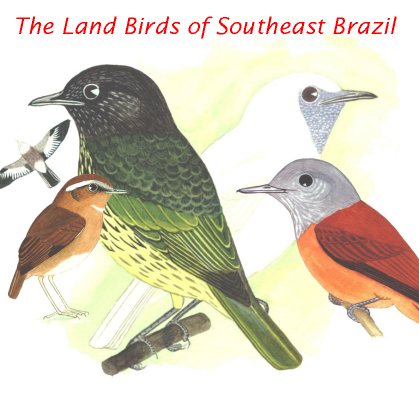
The Land Birds of Southeast Brazil describes over 650 species. Of these species approximately 110 are endemic to the area being covered and another 77 are endemic if a slightly more extended area of southeastern Brazil is covered. At the other end of the spectrum a number of species are included either because they are historically known from the area at a time when its forest cover was much more extensive or because they occur on the periphery of the area and probably also within it although there have been no recent sightings.
The cause of biodiversity in Southeastern Brazil.
The flora and fauna of Southeastern Brazil show a relationship with those of the forests of Amazonia 19 which themselves exhibit a high degree of diversity. It was once thought that the diversity of the Amazon basin was based on the persistence of full-glacial refugia 31, i.e. that during the period of full glaciation the ensuing aridity resulted in the development of savanna areas replacing rain forest so that species became isolated. However recent pollen evidence indicates that there has been no replacement of rainforest by savanna in the last 50,000 years in the Amazonian forests. Instead distribution of endemic species within lowland Amazonia is more likely due to rises of the sea levels taking place during the warm periods 33.
In any case even into historical times, the true rainforest area of the Atlantic coast (the Atlantic Rainforest) which occurs only along a narrow coastal strip, has remained well separated from the Amazonian basin rainforests by extensive areas of dry (semi-deciduous) tropical forests and savannas to the north and west with even some semi-arid areas in the north preventing the movement of species (Pic 2). The area also differs from the Amazon in that it extends considerably further to the south, well beyond the tropics.
Images and recordings on this page
-
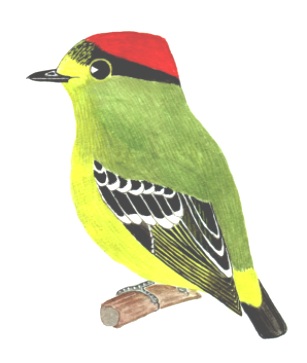
Calyptura cristata -
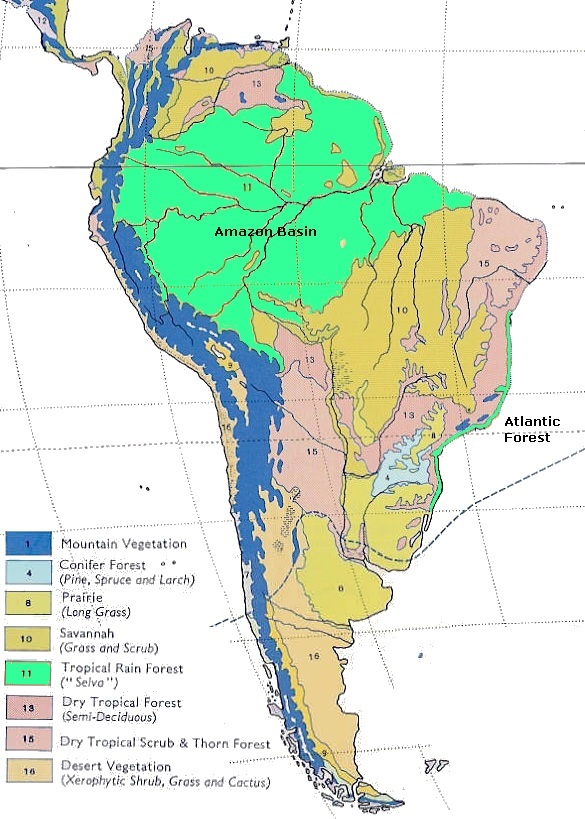
Original Vegetation of South America. The relationship of the Atlantic Forest to the Amazon Basin.
-
Tijuca atra. 10/20/99, Serra Mantiqueira, Agulhas Negras road. Clear, 20°C. High altitude forest, 2000 meters.
Where these come from
The work names each item by a file stem in its own caption records. The captions above are those records with the stem and its separators removed; where an item sat on the original page was not recorded and is not guessed.
- clptcrs1 ^ original-cd/CD01/SEBrazil/PICTURE/clptcrs1.jpg
- trf original-cd/CD01/SEBrazil/PICTURE/Trf.jpg
- 441007 original-cd/CD01/SEBrazil/WAV/441007.wav
Works cited on this page
- 19. Dov Por, F. 1992. Sooretama: the Atlantic Rainforest of Brazil. The Hague: SPB Academic Publishing bv, P. O. Box 97747.
- 31. Haffer, J. 1969 Speciation in Amazonian Forest Birds. Science 165:131-137.
- 33. Nores, M., 1999. An alternative hypothesis for the origin of Amazonian bird diversity. J. Biogeogr. 26:475-485.
Numbers are the work's own; they address the Disc 1 · 2011 bibliography.
This page on the other discs
Disc 2 · 2001
This disc carries the same wording as shown above.
Disc 3 · 2006
This disc carries the same wording as shown above.
Source details
- Release
- Disc 1 · 2011
- Recovered title
- The Species
- Recovered subtitle
- and causes of diversity
- Source location
- original-cd/CD01/SEBrazil/DOCS/Discussn.dat:record=8,offset=512; original-cd/CD01/SEBrazil/DOCS/Sebrazil.dfd:nul_segments=60-65
- Decoded text
- recovered-front-matter-release-aware-v0.1/releases/CD01/INTRODUCTION_TEXT/08.txt
- Page boundaries
- derived from the accepted CD03 boundaries by index-title correspondence plus mechanical segment-stream alignment (CD03 136 segments -> CD01 131 segments); closed by contiguity. This is a provisional sequence: the pages are numbered and titled exactly as the disc's own index records them, but the division of the running text into pages is inferred by this project from the ordered content. The original program's page-link bytes were never decoded, so this is the best-supported order available, not a proven reproduction of the original page flow.
- Text status
- Decoded from the preserved bytes: each byte is one CP1252 character, code point = byte + 31. The work's own markup (font and colour changes, line breaks, scientific-name markers, reference citations) is rendered rather than shown as codes. No spelling, punctuation or typography has been changed.
- Encoding record
- front-matter-encoding-recovery-v0.1