Conservation 1
The plight of the rainfo
The plight of the Atlantic rainforest.
Most of the area covered by this CD was once covered by tropical forests of one form or another. Obviously, the efforts of local and international groups directed towards conservation of natural tropical forest ecosystems frequently fail in light of the pressures of over-population and inequities of wealth and education. Most of the grim pictures forecast in a recent book 18 had already befallen the Atlantic Rainforest long before the dawn of increasing awareness of the progress of destruction of the Earth's rainforests 19. While efforts are launched now to save the remaining Amazonian rainforest, the destruction of the Atlantic Rainforest of Brazil is frequently only briefly mentioned (see e.g. 20).
Maps of São Paulo State show 90-95 % destruction of the forest in this state alone 21 and the destruction still continues. Although in some areas old territory is claimed back by secondary forests, clearing by squatters and poaching are still ongoing and threats by mining companies (such as at Fazenda Intervales) continue unabated. Most of Brazil's protected areas exist only on paper and lack the full protection established by law 23. Some of these current problems might be blamed on the fact that, despite its original longitudinal extension of over 1350 miles this forest is located almost entirely within Brazil and its investigation, management and economical exploitation has always been considered an internal Brazilian affair.
The plight of bamboo specialists.
In the last 50 years such obligatory bamboo seed feeders as Claravis godefrida, Sporophila frontalis and Sporophila falcirostris have become increasingly rare 28. Claravis godefrida was apparently quite common in Rio de Janeiro at the turn of the last century 29, but the last record from the Serra Mantiqueira is from 1989. The distribution of bamboo must have suffered a similar fate as the forest. Edwin Willis thinks that such specialized feeders must have had already difficulties in seeking out new bamboo crops in moderately deforested areas, because of the increased intervals between the bamboo crops. This would make the remaining forested areas too fragmented for these wide ranging food specialists and might also explain why Sporophila frontalis and Sporophila falcirostris were repeatedly found in agricultural areas, such as rice fields 30 which is hopefully an indication that these species can adapt to other food sources.
Conservation efforts.
Most older conservation efforts were directed toward conservation of small forest remnants that were dispersed as small patches surrounded by open country 22. Such small parcels tend to loose a number of tree species because pollination or fruit dispersal of these plants is dependent on vertebrates which are either extinct or for which the large distances between the forest fragments are insurmountable obstacles 24. The consequence is a loss of key vertebrate populations necessary for fruit dispersal and subsequently an irreversible loss of biodiversity of rainforest flora.
Images and recordings on this page
-
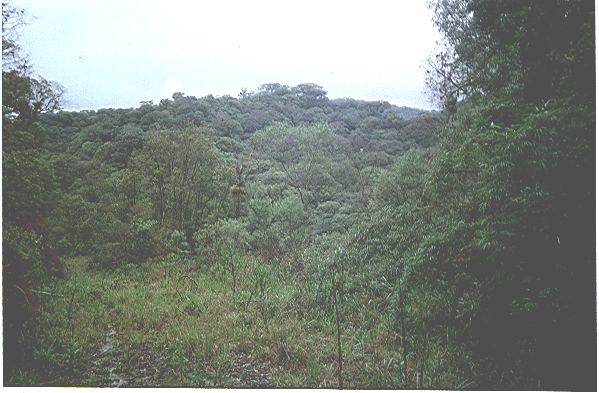
Fazenda Intervales. Forest along the Barra Grande road.
-
Sporophila frontalis, call. Fazenda Intervales, 10/25/00. Cloudy, 20°C. Primary forest with bamboo. With Attila phoenicurus, Basileuterus leucoblepharus, Turdus albicollis, Carpornis cucullatus.
Where these come from
The work names each item by a file stem in its own caption records. The captions above are those records with the stem and its separators removed; where an item sat on the original page was not recorded and is not guessed.
- 5Intrv1 original-cd/CD01/SEBrazil/PICTURE/5Intrv1.jpg
- 441012 original-cd/CD01/SEBrazil/WAV/441012.mp3
Works cited on this page
- 18. Terborgh, J. 1999. Requiem for Nature. Island Press.
- 19. Dov Por, F. 1992. Sooretama: the Atlantic Rainforest of Brazil. The Hague: SPB Academic Publishing bv, P. O. Box 97747.
- 20. Kricher, J. 1997. A Neotropical Companion. Princeton University Press.
- 21. Victor, M.A.M., 1975. A Devastação Florestal. Sociedade de Silvicultura, São Paulo.
- 23. Anonym. May,1999. BBC Wildlife.
- 28. Collar, N.J., Gonzaga, L.P., Krabbe, N, Madroño Nieto, A., Naranjo, L.G., Parker III, T.A., Wedge, D.C., 1992 Threatened Birds of the Americas. The ICBP/IUCN Red Data Book. Smithsonian Institution Press Washington and London.
- 29. Goeldi E.A., 1894. As aves do Brasil. Parte 1. Rio de Janeiro and São Paulo: Livraria Clássica de Aves.
- 30. Sick, H., 1993. Birds in Brazil. A Natural History. Princeton University Press. Princeton NJ.
- 22. Ranta P., Blom T., Niemela J., Joensuu E., and Sitonen, M., 1998. The fragmented atlantic rainforest of Brazil: size, shape and distribution of forest fragments. Biodiversity Cons. 7:385-403.
- 24. Cardoso da Silva, J. M., Tabarelli M. 2000. Tree species impoverishment and the future flora of the Atlantic forest of northeast Brazil. Nature 404: 72-74.
Numbers are the work's own; they address the Disc 1 · 2011 bibliography.
This page on the other discs
Disc 2 · 2001
This disc carries the same wording as shown above.
Disc 3 · 2006
This disc carries the same wording as shown above.
Source details
- Release
- Disc 1 · 2011
- Recovered title
- Conservation 1
- Recovered subtitle
- The plight of the rainfo
- Source location
- original-cd/CD01/SEBrazil/DOCS/Discussn.dat:record=9,offset=576; original-cd/CD01/SEBrazil/DOCS/Sebrazil.dfd:nul_segments=66-71
- Decoded text
- recovered-front-matter-release-aware-v0.1/releases/CD01/INTRODUCTION_TEXT/09.txt
- Page boundaries
- derived from the accepted CD03 boundaries by index-title correspondence plus mechanical segment-stream alignment (CD03 136 segments -> CD01 131 segments); closed by contiguity. This is a provisional sequence: the pages are numbered and titled exactly as the disc's own index records them, but the division of the running text into pages is inferred by this project from the ordered content. The original program's page-link bytes were never decoded, so this is the best-supported order available, not a proven reproduction of the original page flow.
- Text status
- Decoded from the preserved bytes: each byte is one CP1252 character, code point = byte + 31. The work's own markup (font and colour changes, line breaks, scientific-name markers, reference citations) is rendered rather than shown as codes. No spelling, punctuation or typography has been changed.
- Encoding record
- front-matter-encoding-recovery-v0.1