Black-backed Tanager
tangara peruviana
Thraupidae · Tanagers, Honeycreepers
- Disc 2 · 2001 listed
- Disc 3 · 2006 listed
- Disc 1 · 2011 listed
The account
Description
14.5 cm. Male is identical to the male of Tangara preciosa, but the back is shining black.
The female is like the female of Tangara preciosa, but the back yellowish instead of dark green.
-
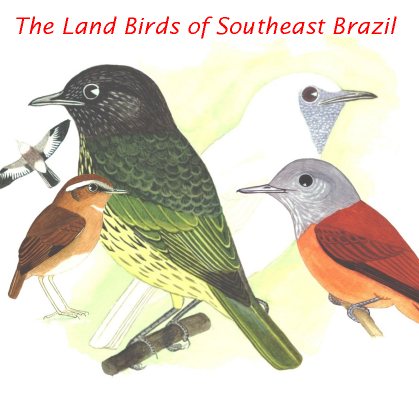
The disc records this picture against the bird without a caption. Disc 3 · 2006
Where it was recorded
The discs' own checklists select Black-backed Tanager at 7 localities.
- Ilha do Cardoso ILSB
- Ilha São Sebastião SSSB
- Jureia-Peruibe JUSB position not recoverable
- Marica MRRB
- PE Jacupiranga PJSB
- Reserva Ecológica Guapiacú RERB
- Rio de Janeiro RIRB
How the map was made
The original program computed each red dot at display time from the locality's coordinates, using its map library and one of five base maps drawn for the screen widths of the day. That library's projection — an oblique rotation of the sphere about the map's own centre, 23.7°S 47.4°W — was read from the program and checked against the graticule the same program drew into the base maps: it reproduces every grid intersection to within about a pixel. The dots here use that projection on the 1280-pixel base map, with the coordinates the discs record. Nothing was placed by hand, no modern map data was used, and a place whose coordinate is incomplete, out of range or beyond the map's edge is listed rather than guessed.
The discs carried location maps only; none shows a distribution or range.
The account, continued
Voice
Call a 'sii' (159). According to Sick (121) the song is similar to that of Thraupis sayaca.
Behavior
Canopy of trees, frequents also shrubs. May be encountered in pairs, alone or in small groups.
Habitat and status
Rare in restinga forest, scrub, and gallery forest close to the coast. Moves inland in winter (119). Severely threatened by destruction of the restinga for beachfront housing. Very little habitat remains throughout the area.
Distribution
Coastal sand plain forests.
In Estado São Paulo observed at Icapara, near Sete Barras, Maruja, Cananeia (119), Ilha do Cardoso (D.F. Stotz, P.Martuscelli, G. Kirwan, unpubl.); also seen near Sao Paulo City, Cantareira, Boraceia, Ipiranga, Itararé, formerly between Santos and Peruibe in an area which is now destroyed by beachfront housing, Jureia. In Estado Rio de Janeiro there are records from Campos, near Macae, Zacarias, Saquarema, Itaborai, Rio de Janeiro (122).
Below 700 meters (133).
Taxonomy notes
Possibly conspecific with Tangara preciosa. Is considered to be "vulnerable" in the Red Data book (122). For more information see 183
Decoded from the disc's own bytes. Each part is shown under the heading the disc files it under, and the wording, spelling and punctuation are the author's.
Across the three discs
The work was published on three discs — Disc 2 in 2001, Disc 3 in 2006 and Disc 1 in 2011. Where they differ, that is a difference between historical releases, and it is never merged away. The 2011 disc is not treated as correcting the earlier ones.
Which discs list this bird
- Disc 2 · 2001 — in this disc's bird list
- Disc 3 · 2006 — in this disc's bird list
- Disc 1 · 2011 — in this disc's bird list
How that was established
- Disc 2 · 2001
aux_nonzero;local_checklist_byte45_flag_1- Disc 3 · 2006
aux_nonzero;local_checklist_byte45_flag_1- Disc 1 · 2011
aux_nonzero;local_checklist_byte45_flag_1
The disc's own record fields that place the bird on its list: a non-empty entry in the species table, and the byte that marks it as selected on a local checklist.
The account in the Disc 1 · 2011 revision
The 2011 Disc 1 revision edited this account; the sections listed below differ from the Disc 3 release text.
Sections with genuine 2011 edits (vs the Disc 3 release): distribution.
Description Disc 1 · 2011
14.5 cm. Male is identical to the male of Tangara preciosa, but the back is shining black.
The female is like the female of Tangara preciosa, but the back yellowish instead of dark green.
Voice Disc 1 · 2011
Call a 'sii' (159). According to Sick (121) the song is similar to that of Thraupis sayaca.
Behavior Disc 1 · 2011
Canopy of trees, frequents also shrubs. May be encountered in pairs, alone or in small groups.
Habitat and status Disc 1 · 2011
Rare in restinga forest, scrub, and gallery forest close to the coast. Moves inland in winter (119). Severely threatened by destruction of the restinga for beachfront housing. Very little habitat remains throughout the area.
Distribution Disc 1 · 2011
Coastal sand plain forests.
In Estado São Paulo observed at Icapara, near Sete Barras, Maruja, Cananeia (119), Ilha do Cardoso (D.F. Stotz, P.Martuscelli, G. Kirwan, unpubl.); also seen near São Paulo City, Cantareira, Boraceia, Ipiranga, Itararé, formerly between Santos and Peruibe in an area which is now destroyed by beachfront housing, Jureia. In Estado Rio de Janeiro there are records from Campos, near Macae, Zacarias, Saquarema, Itaborai, Rio de Janeiro (122).
Below 700 meters (133).
Taxonomy notes Disc 1 · 2011
Possibly conspecific with Tangara preciosa. Is considered to be "vulnerable" in the Red Data book (122). For more information see 183
The work's own taxonomy
The discs carried three parallel name schemes. All three are shown as recovered; none is a modern taxonomy and none has been updated.
| Scheme | Scientific name | English name | Family |
|---|---|---|---|
| WORLD | tangara peruviana | Black-backed Tanager | Thraupidae |
| CLEMENTS | tangara peruviana | Black-backed Tanager | Thraupidae |
| AOU_HM | tangara peruviana | Black-backed Tanager | Thraupidae |
Source details
- Identifier on this site
- seb_species_0403
- Account identifier
- seb_account_0403
- Account number on the disc
- 403
- Source edition
- CD03 / 2006 package
- Original taxonomy scheme
- WORLD
- Structure status
- heuristic; decoded_account_text and segment JSON remain authoritative