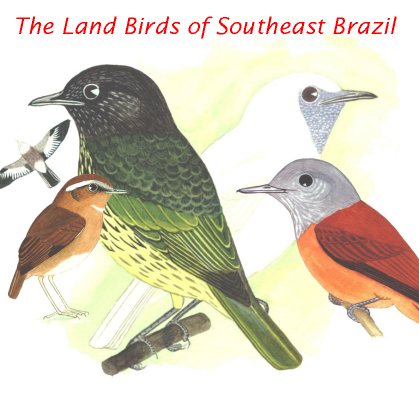
Burnished-buff Tanager
tangara cayana
Thraupidae · Tanagers, Honeycreepers
- Disc 2 · 2001 listed
- Disc 3 · 2006 listed
- Disc 1 · 2011 listed
The account
Description
14 cm. Ochraceous buff above. Wing and tail bluish black. Head sides, throat and band down the middle of chest and belly black. Flanks and crissum light buff.
The female is greenish above with a rufescent crown and a dark grey mask. Wing and tail greenish black. Throat dusky white. Underparts buffy whitish with a greenish hue.
-
Male Disc 3 · 2006 -
Female Disc 3 · 2006
Each plate is labelled with the disc's own caption.
Where it was recorded
The discs' own checklists select Burnished-buff Tanager at 15 localities.
- Assis ASSB
- Barreiro Rico BRSB
- Fazenda Campininha FZSB
- Ilha do Cardoso ILSB
- Itirapina ITSB
- Marica MRRB
- Morro do Diabo MOSB outside the map
- Nucleo Sta. Virginia NUSP
- Reserva Ecológica Guapiacú RERB
- Rio de Janeiro RIRB
- Santa Barbara do Rio Pardo SNSB
- Serra Bocaina SESB
- Serra da Cantareira SRSB
- Serra dos Orgãos SRRB
- Serra dos Tucanos SDTC
How the map was made
The original program computed each red dot at display time from the locality's coordinates, using its map library and one of five base maps drawn for the screen widths of the day. That library's projection — an oblique rotation of the sphere about the map's own centre, 23.7°S 47.4°W — was read from the program and checked against the graticule the same program drew into the base maps: it reproduces every grid intersection to within about a pixel. The dots here use that projection on the 1280-pixel base map, with the coordinates the discs record. Nothing was placed by hand, no modern map data was used, and a place whose coordinate is incomplete, out of range or beyond the map's edge is listed rather than guessed.
The discs carried location maps only; none shows a distribution or range.
The account, continued
Voice
Call a high 'siss'. Song a ' zi zi zi zi-zi zi-zi zi-zi zizizizizizizizizi' lasting about 3 sec (vocalization # 3).
Behavior
Forages in trees and bushes for fruits, takes also termites and other insects; in pairs and small groups.
Breeding
Mato Grosso October, November.
Habitat and status
Not uncommon in dry open areas close to forest or with isolated trees and brush, cerrado, cerradao; in gallery forest, gardens, parks. Seasonally moving around for ripe fruits (159).
Distribution
Throughout, but rare close to the coast, e. g. in Estado São Paulo it was encountered at Itapetininga, Capao Bonito, Bananal, Sao Jose do Barreiro (119), São Paulo City. In Estado Rio de Janeiro observed at Teresopolis, Rio de Janeiro, Lajes, Santa Cecilia, Refugio do Marapendi (12 km west of Rio de Janeiro), Itatiaia (53).
Below 1200 meters (133)
Decoded from the disc's own bytes. Each part is shown under the heading the disc files it under, and the wording, spelling and punctuation are the author's.
Vocalizations
-
Song. Serra das Rosas São Paulo, near Franca, 11/7/98. Rain in the morning, then sunny, 27°C. Secondary forest. With Myiarchus swainsoni.
-
Call. Ibitiboca, 10/31/00. Cloudy, 20°C. Open forest.
-
Calls, Bolivar, Venezuela, LNS 16462, recorded by P. Kellogg.
Recording files on the disc
- 9041.mp3 Song. Serra das Rosas São Paulo, near Franca, 11/7/98. Rain in the morning, then sunny, 27°C. Secondary forest. With Myiarchus swainsoni.
- 11139.mp3 Call. Ibitiboca, 10/31/00. Cloudy, 20°C. Open forest.
- 3175.mp3 Calls, Bolivar, Venezuela, LNS 16462, recorded by P. Kellogg.
Across the three discs
The work was published on three discs — Disc 2 in 2001, Disc 3 in 2006 and Disc 1 in 2011. Where they differ, that is a difference between historical releases, and it is never merged away. The 2011 disc is not treated as correcting the earlier ones.
Which discs list this bird
- Disc 2 · 2001 — in this disc's bird list
- Disc 3 · 2006 — in this disc's bird list
- Disc 1 · 2011 — in this disc's bird list
How that was established
- Disc 2 · 2001
aux_nonzero;local_checklist_byte45_flag_1- Disc 3 · 2006
aux_nonzero;local_checklist_byte45_flag_1- Disc 1 · 2011
aux_nonzero;local_checklist_byte45_flag_1
The disc's own record fields that place the bird on its list: a non-empty entry in the species table, and the byte that marks it as selected on a local checklist.
The account in the Disc 1 · 2011 revision
The 2011 Disc 1 revision edited this account; the sections listed below differ from the Disc 3 release text.
Sections with genuine 2011 edits (vs the Disc 3 release): distribution.
Description Disc 1 · 2011
14 cm. Ochraceous buff above. Wing and tail bluish black. Head sides, throat and band down the middle of chest and belly black. Flanks and crissum light buff.
The female is greenish above with a rufescent crown and a dark grey mask. Wing and tail greenish black. Throat dusky white. Underparts buffy whitish with a greenish hue.
Voice Disc 1 · 2011
Call a high 'siss'. Song a ' zi zi zi zi-zi zi-zi zi-zi zizizizizizizizizi' lasting about 3 sec (vocalization # 3).
Behavior Disc 1 · 2011
Forages in trees and bushes for fruits, takes also termites and other insects; in pairs and small groups.
Breeding Disc 1 · 2011
Mato Grosso October, November.
Habitat and status Disc 1 · 2011
Not uncommon in dry open areas close to forest or with isolated trees and brush, cerrado, cerradao; in gallery forest, gardens, parks. Seasonally moving around for ripe fruits (159).
Distribution Disc 1 · 2011
Throughout, but rare close to the coast, e. g. in Estado São Paulo it was encountered at Itapetininga, Capao Bonito, Bananal, São Jose do Barreiro (119), São Paulo City. In Estado Rio de Janeiro observed at Teresopolis, Rio de Janeiro, Lajes, Santa Cecilia, Refugio do Marapendi (12 km west of Rio de Janeiro), Itatiaia (53).
Below 1200 meters (133)
The work's own taxonomy
The discs carried three parallel name schemes. All three are shown as recovered; none is a modern taxonomy and none has been updated.
| Scheme | Scientific name | English name | Family |
|---|---|---|---|
| WORLD | tangara cayana | Burnished-buff Tanager | Thraupidae |
| CLEMENTS | tangara cayana | Burnished-buff Tanager | Thraupidae |
| AOU_HM | tangara cayana | Burnished-buff Tanager | Thraupidae |
Source details
- Identifier on this site
- seb_species_0402
- Account identifier
- seb_account_0402
- Account number on the disc
- 402
- Source edition
- CD03 / 2006 package
- Original taxonomy scheme
- WORLD
- Structure status
- heuristic; decoded_account_text and segment JSON remain authoritative