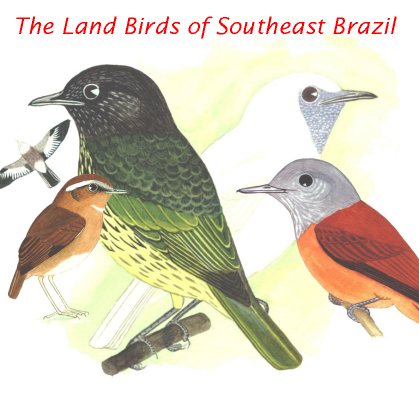
Yellow-rumped Flycatcher
myiobius mastacalis
Tyrannidae,Fluvicolinae · Fluvicoline Flycatchers
- Disc 2 · 2001 listed
- Disc 3 · 2006 listed
- Disc 1 · 2011 listed
The account
Description
12 cm. Olive-green above with a concealed yellow coronal patch in the male. Wings dark grayish, without wing bars. Rump sulphur-yellow. Throat yellow. Breast brownish-olive-tawny. Belly yellowish. Tail dark grey.
-
The disc records this picture against the bird without a caption. Disc 3 · 2006
Where it was recorded
The discs' own checklists select Yellow-rumped Flycatcher at 16 localities.
- Angra dos Reis ANRB
- Campos do Jordão CASB
- Fazenda Intervales FASB
- Ilha do Cardoso ILSB
- Ilha São Sebastião SSSB
- Jureia-Peruibe JUSB position not recoverable
- Nucleo Sta. Virginia NUSP
- Parati PARB
- PE Jacupiranga PJSB
- Reserva Ecológica Guapiacú RERB
- Rio de Janeiro RIRB
- Serra Bocaina SESB
- Serra dos Orgãos SRRB
- Serra dos Tucanos SDTC
- Sete Barras STSB
- Ubatuba UBSB
How the map was made
The original program computed each red dot at display time from the locality's coordinates, using its map library and one of five base maps drawn for the screen widths of the day. That library's projection — an oblique rotation of the sphere about the map's own centre, 23.7°S 47.4°W — was read from the program and checked against the graticule the same program drew into the base maps: it reproduces every grid intersection to within about a pixel. The dots here use that projection on the 1280-pixel base map, with the coordinates the discs record. Nothing was placed by hand, no modern map data was used, and a place whose coordinate is incomplete, out of range or beyond the map's edge is listed rather than guessed.
The discs carried location maps only; none shows a distribution or range.
The account, continued
Voice
Not very vocal, the call is a high pitched 'chzit' repeated several times.
Behavior
This species moves through the undergrowth with rapid flights, short pauses, and active wing and tail flashing in the manner of redstarts. Foraging consists of enclosed perch hawking within dense undergrowth 1-3 meters above ground using sally-gleans (upward strikes and upward hover gleans) at least as often as aerial hawks. (74).
Breeding
Nest is a pocket with covered side entrance (77).
Habitat and status
A flycatcher of the lower growth of humid forest interior. Quite common in secondary and primary rain forest and gallery forest.
Distribution
Throughout. Serra do Mar, Serra Mantiqueira, Serra dos Orgãos, Fazenda Intervales, Iguape (40), Cananeia, Ilha do Cardoso. To 1000 meters.
Taxonomy notes
Split from Myiobius barbatus as suggested by Hellmayr (105).
Decoded from the disc's own bytes. Each part is shown under the heading the disc files it under, and the wording, spelling and punctuation are the author's.
Vocalizations
-
Call. Cornell Cat#48314. Sooretama, Espirito Santo, 9/23/88. Recording by P. Isler.
Recording files on the disc
- 14532.wav Call. Cornell Cat#48314. Sooretama, Espirito Santo, 9/23/88. Recording by P. Isler.
Across the three discs
The work was published on three discs — Disc 2 in 2001, Disc 3 in 2006 and Disc 1 in 2011. Where they differ, that is a difference between historical releases, and it is never merged away. The 2011 disc is not treated as correcting the earlier ones.
Which discs list this bird
- Disc 2 · 2001 — in this disc's bird list
- Disc 3 · 2006 — in this disc's bird list
- Disc 1 · 2011 — in this disc's bird list
How that was established
- Disc 2 · 2001
aux_nonzero;local_checklist_byte45_flag_1- Disc 3 · 2006
aux_nonzero;local_checklist_byte45_flag_1- Disc 1 · 2011
aux_nonzero;local_checklist_byte45_flag_1
The disc's own record fields that place the bird on its list: a non-empty entry in the species table, and the byte that marks it as selected on a local checklist.
The account in the Disc 1 · 2011 revision
The 2011 Disc 1 revision carries this account text unchanged from the Disc 3 release.
The work's own taxonomy
The discs carried three parallel name schemes. All three are shown as recovered; none is a modern taxonomy and none has been updated.
| Scheme | Scientific name | English name | Family |
|---|---|---|---|
| WORLD | myiobius mastacalis | Yellow-rumped Flycatcher | Tyrannidae,Fluvicolinae |
| CLEMENTS | myiobius mastacalis | Yellow-rumped Flycatcher | Tyrannidae,Fluvicolinae |
| AOU_HM | muscicapa mastacalis | Yellow-rumped Flycatcher | None |
Source details
- Identifier on this site
- seb_species_0244
- Account identifier
- seb_account_0244
- Account number on the disc
- 244
- Source edition
- CD03 / 2006 package
- Original taxonomy scheme
- WORLD
- Structure status
- heuristic; decoded_account_text and segment JSON remain authoritative