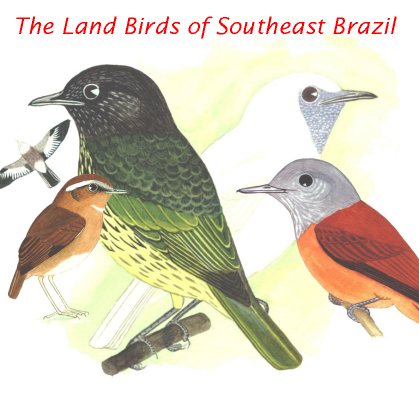
Gray-backed Tachuri
polystictus superciliaris
Tyrannidae,Elaeninae · Tyrannulets
- Disc 2 · 2001 listed
- Disc 3 · 2006 listed
- Disc 1 · 2011 listed
The account
Description
9 cm. Above brownish-gray with a black stripe through the eye and a prominent white superciliary. Wings dark grayish-brown, with two lighter grayish wing bars Below cinnamon buff with a white belly. Tail dark grayish-brown the outer feathers with white borders.
Juvenile has a whitish superciliary stripe, cream-colored belly and a shorter tail (81).
-
The disc records this picture against the bird without a caption. Disc 3 · 2006
The account, continued
Voice
Call a double syllabled repeated 'tee duck', the second syllable with lower pitch (cut #2). Song a fast trill which rises slightly in pitch 'tititititititititititititiprrrrrrrtitititititi' (cut #1). Vasconcelos describes the common call as 'pilup-pilup-pilup-pilup....' and as 'fruilrilrilrilrilrilrilril.....'.
Behavior
Forages in pairs or small groups in low scrub and grassy areas with bushes. A perch gleaner.
Breeding
A cup shaped nest was discovered July 6, 1996, at Serra do Curral. (81).
Habitat and status
An endemic tyrannid of the serras. Local in rock-strewn grassy slopes and table land with open bushy areas.
Distribution
In Estado São Paulo reported from the upper part of the Serra Bocaina near Bananal, Lima JL, 1961 (30).
Decoded from the disc's own bytes. Each part is shown under the heading the disc files it under, and the wording, spelling and punctuation are the author's.
Vocalizations
-
Calls. Serra do Cipo, 11/16/98. Sunny, 20°C. Open scrub. With Elaenia cristata, Zonotrichia capensis.
-
Call. Serra do Cipo, 11/16/98. Sunny, 25°C. Open scrub.
Recording files on the disc
- 11129.mp3 Calls. Serra do Cipo, 11/16/98. Sunny, 20°C. Open scrub. With Elaenia cristata, Zonotrichia capensis.
- 13161.mp3 Call. Serra do Cipo, 11/16/98. Sunny, 25°C. Open scrub.
Across the three discs
The work was published on three discs — Disc 2 in 2001, Disc 3 in 2006 and Disc 1 in 2011. Where they differ, that is a difference between historical releases, and it is never merged away. The 2011 disc is not treated as correcting the earlier ones.
Which discs list this bird
- Disc 2 · 2001 — in this disc's bird list
- Disc 3 · 2006 — in this disc's bird list
- Disc 1 · 2011 — in this disc's bird list
How that was established
- Disc 2 · 2001
aux_nonzero- Disc 3 · 2006
aux_nonzero- Disc 1 · 2011
aux_nonzero
The disc's own record fields that place the bird on its list: a non-empty entry in the species table, and the byte that marks it as selected on a local checklist.
The account in the Disc 1 · 2011 revision
The 2011 Disc 1 revision carries this account text unchanged from the Disc 3 release.
The work's own taxonomy
The discs carried three parallel name schemes. All three are shown as recovered; none is a modern taxonomy and none has been updated.
| Scheme | Scientific name | English name | Family |
|---|---|---|---|
| WORLD | polystictus superciliaris | Gray-backed Tachuri | Tyrannidae,Elaeninae |
| CLEMENTS | polystictus superciliaris | Gray-backed Tachuri | Tyrannidae,Elaeninae |
| AOU_HM | polystictus superciliaris | Gray-backed Tachuri | Tyrannidae,Elaeninae |
Source details
- Identifier on this site
- seb_species_0220
- Account identifier
- seb_account_0220
- Account number on the disc
- 220
- Source edition
- CD03 / 2006 package
- Original taxonomy scheme
- WORLD
- Structure status
- heuristic; decoded_account_text and segment JSON remain authoritative