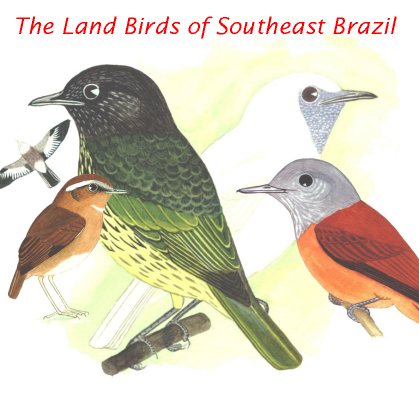
Black-capped Manakin
piprites pileatus
Pipridae · Manakins
- Disc 2 · 2001 listed
- Disc 3 · 2006 listed
- Disc 1 · 2011 listed
The account
Description
11 cm. A striking bird. Bill and legs yellow.
The male has a black crown and nape and a chestnut back, rump and wing coverts. Wings blackish with yellowish margins to the flight feathers and a single yellow bar. Below buff-cinnamon. Tail rusty with black central feathers.
The female is similar, but the back is olive and it has light grayish yellow wingbars. Below yellowish.
-
The disc records this picture against the bird without a caption. Disc 3 · 2006
Where it was recorded
The discs' own checklists select Black-capped Manakin at 3 localities.
- Campos do Jordão CASB
- Reserva Ecológica Guapiacú RERB
- Serra Bocaina SESB
How the map was made
The original program computed each red dot at display time from the locality's coordinates, using its map library and one of five base maps drawn for the screen widths of the day. That library's projection — an oblique rotation of the sphere about the map's own centre, 23.7°S 47.4°W — was read from the program and checked against the graticule the same program drew into the base maps: it reproduces every grid intersection to within about a pixel. The dots here use that projection on the 1280-pixel base map, with the coordinates the discs record. Nothing was placed by hand, no modern map data was used, and a place whose coordinate is incomplete, out of range or beyond the map's edge is listed rather than guessed.
The discs carried location maps only; none shows a distribution or range.
The account, continued
Voice
Call a 'pep... pep... pep.... piu....'. Also a call sequence such as 'piu-pididididididi-piu'. Females seem to give a 'cheenh' (44). Frugivorous (30).
Behavior
Forages rapidly through middle and upper strata of trees. Often in mixed bird parties.
Habitat and status
Rare in primary and secondary mature montane forest. In the south apparently mainly in mixed forest. With Araucaria and Podocarpus. This species is listed as 'vulnerable' because the disappearance of suitable forest (103).
Distribution
Rare on the lower Agulhas Negras road and Jeep trail,Itatiaia, Serra Mantiqueira. The road to São Jose dos Alpes, Campos do Jordão (Willis E.O.), Serra Bocaina (1600 meters, Sick), Nova Friburgo (40). From 1000-1800 meters.
Taxonomy notes
For more information see 186
Decoded from the disc's own bytes. Each part is shown under the heading the disc files it under, and the wording, spelling and punctuation are the author's.
Vocalizations
-
Call, song. Cornell Cat#19360. São Francisco de Paula, Rio Grande do Sul, 1/21/76. With Procnias nudicollis, Chamaeza meruloides, Pachyramphus polychopterus. Recording by W. Belton.
Recording files on the disc
- 9463.wav Call, song. Cornell Cat#19360. São Francisco de Paula, Rio Grande do Sul, 1/21/76. With Procnias nudicollis, Chamaeza meruloides, Pachyramphus polychopterus. Recording by W. Belton.
More images
Montane forest. Serra da Mantiqueira on the Agulhas Negras road. Biome of Piprites pileatus. Disc 3 · 2006
Across the three discs
The work was published on three discs — Disc 2 in 2001, Disc 3 in 2006 and Disc 1 in 2011. Where they differ, that is a difference between historical releases, and it is never merged away. The 2011 disc is not treated as correcting the earlier ones.
Which discs list this bird
- Disc 2 · 2001 — in this disc's bird list
- Disc 3 · 2006 — in this disc's bird list
- Disc 1 · 2011 — in this disc's bird list
How that was established
- Disc 2 · 2001
aux_nonzero;local_checklist_byte45_flag_1- Disc 3 · 2006
aux_nonzero;local_checklist_byte45_flag_1- Disc 1 · 2011
aux_nonzero;local_checklist_byte45_flag_1
The disc's own record fields that place the bird on its list: a non-empty entry in the species table, and the byte that marks it as selected on a local checklist.
The account in the Disc 1 · 2011 revision
The 2011 Disc 1 revision carries this account text unchanged from the Disc 3 release.
The work's own taxonomy
The discs carried three parallel name schemes. All three are shown as recovered; none is a modern taxonomy and none has been updated.
| Scheme | Scientific name | English name | Family |
|---|---|---|---|
| WORLD | piprites pileatus | Black-capped Manakin | Pipridae |
| CLEMENTS | piprites pileatus | Black-capped Manakin | Pipridae |
| AOU_HM | piprites pileatus | Black-capped Manakin | Pipridae |
Source details
- Identifier on this site
- seb_species_0185
- Account identifier
- seb_account_0185
- Account number on the disc
- 185
- Source edition
- CD03 / 2006 package
- Original taxonomy scheme
- WORLD
- Structure status
- heuristic; decoded_account_text and segment JSON remain authoritative