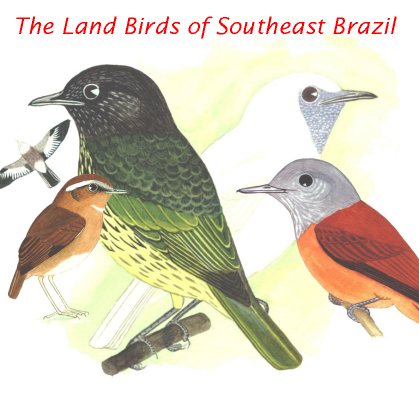
Black-hooded Antwren
formicivora erythronotos
Thamnophilidae · Antbirds, Antwrens
- Disc 2 · 2001 listed
- Disc 3 · 2006 listed
- Disc 1 · 2011 listed
The account
Description
11 cm. A small compact Formicivora whose jizz resembles more that of a Myrmotherula antwren. Male head, breast, belly, tail and wings black. Flanks white. Back strikingly rufous-chestnut. Wings with white bars, the wing coverts fringed white.
Female is like the male, but is brownish-olive where the male is black. Chest and belly pale buff.
-
The disc records this picture against the bird without a caption. Disc 3 · 2006
Where it was recorded
The discs' own checklists select Black-hooded Antwren at 2 localities.
- Angra dos Reis ANRB
- Parati PARB
How the map was made
The original program computed each red dot at display time from the locality's coordinates, using its map library and one of five base maps drawn for the screen widths of the day. That library's projection — an oblique rotation of the sphere about the map's own centre, 23.7°S 47.4°W — was read from the program and checked against the graticule the same program drew into the base maps: it reproduces every grid intersection to within about a pixel. The dots here use that projection on the 1280-pixel base map, with the coordinates the discs record. Nothing was placed by hand, no modern map data was used, and a place whose coordinate is incomplete, out of range or beyond the map's edge is listed rather than guessed.
The discs carried location maps only; none shows a distribution or range.
The account, continued
Voice
Song is a punctuated stacatto 'tektektektektektek'. Calls, 'tju tju', a 'reeee reeee' and a shorter 'jep jep jep'. The identity of cut # 1, a high stacatto "ti ti ti ti ti......" as to belonging to this species is uncertain.
Behavior
Forages up to 2 meters from the ground in dense bush. Not difficult to see and quite confiding. Where found, relatively numerous in pairs and groups, but not in mixed flocks.
Habitat and status
In underbrush of humid open secondary woodland and in dense scrubby areas and hedges. Seems to accept also overgrown scrubby fields, roadside scrub and gallery scrub adjacent to wet meadows etc. At the rediscovery site Eucalyptus trees over humid secondary forest with dense understory on swampy ground and standing water. Part of the area has a narrow fringe of mangroves (65). This species has been downgraded from 'critical' to 'vulnerable' , as it is known now from seven sites (103). However ongoing habitat loss will likely result in a declining total population.
Distribution
Very local in the Angra dos Reis area and Baía da Ilha Grande (Cunhambebe, Pereque) of Estado Rio de Janeiro at sea level. Was also seen north of Angra dos Reis and close to the coastal Route 101 northwest of Angra dos Reis in restinga scrub (Forrester, in litt.) Endangered by development.
Taxonomy notes
This striking species was rediscovered near Angra dos Reis, Estado Rio de Janeiro in 1987 after being lost for 135 years (64). Although put in the genusFormicivora it has a jizz different from that of typical Formicivora antwrens and seems to have characteristics common to Formicivora and to Myrmotherula. For more information see 176
Decoded from the disc's own bytes. Each part is shown under the heading the disc files it under, and the wording, spelling and punctuation are the author's.
Vocalizations
-
Call, Pereque, Angra dos Reis, Rio de Janeiro, 10/99, scrub, 27°C. Sunny.
-
Song. Pereque, near Angra dos Reis, 10/16/99. Sunny, 30°C. Open scrub. With Zonotrichia capensis, Trogon viridis, Cacicus haemorrhous, Capsiempis flaveolus, Pyriglena leucoptera.
-
Calls. Pereque, near Angra dos Reis, 10/16/99. Sunny, 30°C. Scrub with trees. With Turdus rufiventris.
-
Double syllable calls. 10/16/99, Pereque, near Angra dos Reis. Sunny, 30°C. Open woodland with dense undergrowth. With Pyriglena leucoptera, Turdus rufiventris, Phacellodomus erythropthalmus.
-
Song. Pereque, near Angra dos Reis, 10/17/99. Sunny, 30°C. Open scrub, secondary forest. With Hylophilus thoracicus, Turdus rufiventris.
Recording files on the disc
- 8890.wav Call, Pereque, Angra dos Reis, Rio de Janeiro, 10/99, scrub, 27°C. Sunny.
- 7721.wav Song. Pereque, near Angra dos Reis, 10/16/99. Sunny, 30°C. Open scrub. With Zonotrichia capensis, Trogon viridis, Cacicus haemorrhous, Capsiempis flaveolus, Pyriglena leucoptera.
- 8368.wav Calls. Pereque, near Angra dos Reis, 10/16/99. Sunny, 30°C. Scrub with trees. With Turdus rufiventris.
- 15375.wav Double syllable calls. 10/16/99, Pereque, near Angra dos Reis. Sunny, 30°C. Open woodland with dense undergrowth. With Pyriglena leucoptera, Turdus rufiventris, Phacellodomus erythropthalmus.
- 9880.wav Song. Pereque, near Angra dos Reis, 10/17/99. Sunny, 30°C. Open scrub, secondary forest. With Hylophilus thoracicus, Turdus rufiventris.
Across the three discs
The work was published on three discs — Disc 2 in 2001, Disc 3 in 2006 and Disc 1 in 2011. Where they differ, that is a difference between historical releases, and it is never merged away. The 2011 disc is not treated as correcting the earlier ones.
Which discs list this bird
- Disc 2 · 2001 — in this disc's bird list
- Disc 3 · 2006 — in this disc's bird list
- Disc 1 · 2011 — in this disc's bird list
How that was established
- Disc 2 · 2001
aux_nonzero;local_checklist_byte45_flag_1- Disc 3 · 2006
aux_nonzero;local_checklist_byte45_flag_1- Disc 1 · 2011
aux_nonzero;local_checklist_byte45_flag_1
The disc's own record fields that place the bird on its list: a non-empty entry in the species table, and the byte that marks it as selected on a local checklist.
The account in the Disc 1 · 2011 revision
In the 2011 Disc 1 revision, part of this account was truncated at exactly 512 bytes (a 2011 mastering defect). The earlier releases preserve the complete text.
Truncated sections in the 2011 revision: habitat_status. The complete earlier text is shown beneath each truncated section.
Description Disc 1 · 2011
11 cm. A small compact Formicivora whose jizz resembles more that of a Myrmotherula antwren. Male head, breast, belly, tail and wings black. Flanks white. Back strikingly rufous-chestnut. Wings with white bars, the wing coverts fringed white.
Female is like the male, but is brownish-olive where the male is black. Chest and belly pale buff.
Voice Disc 1 · 2011
Song is a punctuated stacatto 'tektektektektektek'. Calls, 'tju tju', a 'reeee reeee' and a shorter 'jep jep jep'. The identity of cut # 1, a high stacatto "ti ti ti ti ti......" as to belonging to this species is uncertain.
Behavior Disc 1 · 2011
Forages up to 2 meters from the ground in dense bush. Not difficult to see and quite confiding. Where found, relatively numerous in pairs and groups, but not in mixed flocks.
Habitat and status Disc 1 · 2011
In underbrush of humid open secondary woodland and in dense scrubby areas and hedges. Seems to accept also overgrown scrubby fields, roadside scrub and gallery scrub adjacent to wet meadows etc. At the rediscovery site Eucalyptus trees over humid secondary forest with dense understory on swampy ground and standing water. Part of the area has a narrow fringe of mangroves (65). This species has been downgraded from 'critical' to 'vulnerable' , as it is known now from seven sites (103). However ongoing habit
Disc 1 (2011) text ends here — truncated at exactly 512 bytes in the 2011 mastering (historical defect, kept as recovered).
Complete earlier text — Disc 3 · 2006 (59 bytes lost in 2011)
In underbrush of humid open secondary woodland and in dense scrubby areas and hedges. Seems to accept also overgrown scrubby fields, roadside scrub and gallery scrub adjacent to wet meadows etc. At the rediscovery site Eucalyptus trees over humid secondary forest with dense understory on swampy ground and standing water. Part of the area has a narrow fringe of mangroves (65). This species has been downgraded from 'critical' to 'vulnerable' , as it is known now from seven sites (103). However ongoing habitat loss will likely result in a declining total population.
Shown for comparison from the Disc 3 · 2006; it does not repair or replace the Disc 1 · 2011 historical text above.
Distribution Disc 1 · 2011
Very local in the Angra dos Reis area and Baía da Ilha Grande (Cunhambebe, Pereque) of Estado Rio de Janeiro at sea level. Was also seen north of Angra dos Reis and close to the coastal Route 101 northwest of Angra dos Reis in restinga scrub (Forrester, in litt.) Endangered by development.
Taxonomy notes Disc 1 · 2011
This striking species was rediscovered near Angra dos Reis, Estado Rio de Janeiro in 1987 after being lost for 135 years (64). Although put in the genusFormicivora it has a jizz different from that of typical Formicivora antwrens and seems to have characteristics common to Formicivora and to Myrmotherula. For more information see 176
The work's own taxonomy
The discs carried three parallel name schemes. All three are shown as recovered; none is a modern taxonomy and none has been updated.
| Scheme | Scientific name | English name | Family |
|---|---|---|---|
| WORLD | formicivora erythronotos | Black-hooded Antwren | Thamnophilidae |
| CLEMENTS | formicivora erythronotos | Black-hooded Antwren | Thamnophilidae |
| AOU_HM | formicivora erythronotos | Black-hooded Antwren | Thamnophilidae |
Open questions about this bird
Recovered evidence that has not been settled. It is published because leaving it out would misrepresent what the discs contain.
Later listening, kept separate from the disc's own claims
content_441006 — historical_target: FORMICIVORA ERYTHRONOTOS (historical_source)
Source details
- Identifier on this site
- seb_species_0136
- Account identifier
- seb_account_0136
- Account number on the disc
- 136
- Source edition
- CD03 / 2006 package
- Original taxonomy scheme
- WORLD
- Structure status
- heuristic; decoded_account_text and segment JSON remain authoritative