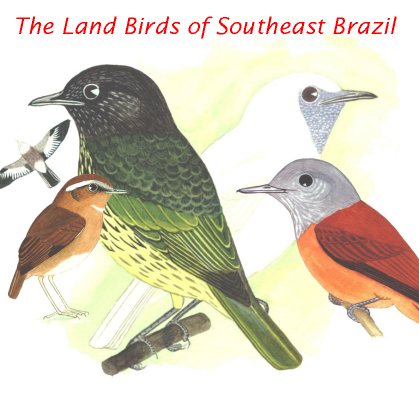
Chestnut-capped Foliage-gleaner
hylocryptus rectirostris
Furnariidae,Philydorinae · Foliage-gleaners
- Disc 2 · 2001 listed
- Disc 3 · 2006 listed
- Disc 1 · 2011 listed
The account
Description
20 cm. A big rust-brown Furnariid of gallery forest. Long straight bill grayish-yellow. Eyes yellowish-white. No superciliary. Crown and upper wing reddish-brown. Rest of upper parts cinnamon rufous.Throat pale cinnamon, paler than the rest of the ochraceous-buff underparts that become brownish on the flanks and reddish-brown on the crissum. Tail long and rufous.
-
The disc records this picture against the bird without a caption. Disc 3 · 2006
The account, continued
Voice
A series of loud and characteristic chicken-like 'wat wat wat.....". Also a faster 'kekekekekekeke'.
Behavior
Forages singly or in pairs close to the ground in thickets usually near water.
Breeding
The nest is at the end of a burrow.
Habitat and status
In northern Estado do São Paulo and Minas Gerais not especially uncommon in suitable habitat. Inhabits the interior of southeastern Brazil, usually in dense dry forest close to water.
Distribution
In 1992 and 1997 this species was found in the neighborhood of Paulinia, 30 km northwest of Campinas, Estado do São Paulo (96) making it possible that it might occur in campos closer to the coast. To about 1000 meters.
Taxonomy notes
Vaurie put this species and H. erythrocephalus of southwest Ecuador and northwest Peru in the genus Automolus (41).
Decoded from the disc's own bytes. Each part is shown under the heading the disc files it under, and the wording, spelling and punctuation are the author's.
Vocalizations
-
Calls. 11/14/98 Pirapora, Minas Gerais. Sunny, some clouds, 27°C. With Basileuterus flaveolus, Lepidocolaptes angustirostris, Gallus domesticus.
Recording files on the disc
- 7955.mp3 Calls. 11/14/98 Pirapora, Minas Gerais. Sunny, some clouds, 27°C. With Basileuterus flaveolus, Lepidocolaptes angustirostris, Gallus domesticus.
Across the three discs
The work was published on three discs — Disc 2 in 2001, Disc 3 in 2006 and Disc 1 in 2011. Where they differ, that is a difference between historical releases, and it is never merged away. The 2011 disc is not treated as correcting the earlier ones.
Which discs list this bird
- Disc 2 · 2001 — in this disc's bird list
- Disc 3 · 2006 — in this disc's bird list
- Disc 1 · 2011 — in this disc's bird list
How that was established
- Disc 2 · 2001
aux_nonzero- Disc 3 · 2006
aux_nonzero- Disc 1 · 2011
aux_nonzero
The disc's own record fields that place the bird on its list: a non-empty entry in the species table, and the byte that marks it as selected on a local checklist.
The account in the Disc 1 · 2011 revision
The 2011 Disc 1 revision carries this account text unchanged from the Disc 3 release.
The work's own taxonomy
The discs carried three parallel name schemes. All three are shown as recovered; none is a modern taxonomy and none has been updated.
| Scheme | Scientific name | English name | Family |
|---|---|---|---|
| WORLD | hylocryptus rectirostris | Chestnut-capped Foliage-gleaner | Furnariidae,Philydorinae |
| CLEMENTS | hylocryptus rectirostris | Chestnut-capped Foliage-gleaner | Furnariidae,Philydorinae |
| AOU_HM | hylocryptus rectirostris | Chestnut-capped Foliage-gleaner | Furnariidae,Philydorinae |
Source details
- Identifier on this site
- seb_species_0093
- Account identifier
- seb_account_0093
- Account number on the disc
- 93
- Source edition
- CD03 / 2006 package
- Original taxonomy scheme
- WORLD
- Structure status
- heuristic; decoded_account_text and segment JSON remain authoritative