Vinaceous-breasted Parrot
amazona vinacea
Psittacidae,Nestorinae\x00in part) · New World Parrots
- Disc 2 · 2001 listed
- Disc 3 · 2006 listed
- Disc 1 · 2011 listed
The account
Description
30 cm. Bill, frontal band and lores red, the rest of the head green with dark edging on crown. Nape and sides of neck pale blue, the feathers with dark edges. Breast and belly purple, the feathers with dark edges. Back and wings dark green, the wings with a red and yellow carpal area and a red speculum, the primaries with turquoise outer webs and blue tips. Tail green with a narrow yellow terminal band and the basal part of the outer feathers dull red.
The immature has reduced red lores, reduced green on breast and a reduced yellow carpal area.
-
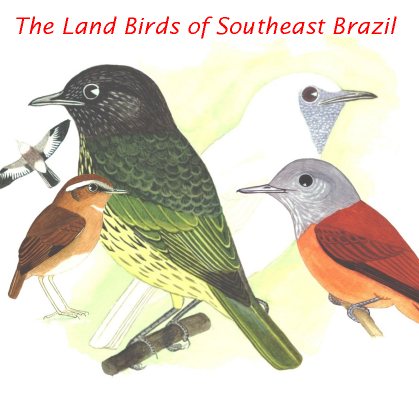
The disc records this picture against the bird without a caption. Disc 3 · 2006
Where it was recorded
The discs' own checklists select Vinaceous-breasted Parrot at 3 localities.
- Campos do Jordão CASB
- PE Jacupiranga PJSB
- Reserva Ecológica Guapiacú RERB
How the map was made
The original program computed each red dot at display time from the locality's coordinates, using its map library and one of five base maps drawn for the screen widths of the day. That library's projection — an oblique rotation of the sphere about the map's own centre, 23.7°S 47.4°W — was read from the program and checked against the graticule the same program drew into the base maps: it reproduces every grid intersection to within about a pixel. The dots here use that projection on the 1280-pixel base map, with the coordinates the discs record. Nothing was placed by hand, no modern map data was used, and a place whose coordinate is incomplete, out of range or beyond the map's edge is listed rather than guessed.
The discs carried location maps only; none shows a distribution or range.
The account, continued
Voice
Call 'grau grau, 'yok yok' , 'yokyokgrau yokyokgrau..'
Behavior
Forages in canopy of tall trees, araucarias, mostly in flocks. The association with araucarias is not clear.
Breeding
November, December. Nests in a hole of an Araucaria or other tree.
Habitat and status
Locally common in highland forest, possibly associated with araucarias.
Distribution
Estado Rio de Janeiro, was found near Nova Friburgo (1828), near Valenca at 400 meters (1990). In Estado São Paulo found at Timburi,PE Jacupiranga, Barra do Turvo, Iporanga, Fazenda Intervales (119), Campos do Jordão at 1800 meters
Taxonomy notes
Endemic to the Atlantic forest. Endangered due to habitat loss and trapping (122).
Decoded from the disc's own bytes. Each part is shown under the heading the disc files it under, and the wording, spelling and punctuation are the author's.
Vocalizations
-
Calls. 10/27/99, Campos do Jordão. Clear, cool, 15 °C. Open Araucaria forest. With Pitangus sulphuratus, Brotogeris tirica, Turdus rufiventris.
-
Calls. 10/27/99, Campos do Jordão. Clear, 15 °C. Open Araucaria forest. With Leptasthenura setaria.
-
Calls. 10/27/99, Campos do Jordão, road to São Jose dos Alpes. Clear, 25°C. Open forest. With Pionus maximiliani, Cyclarhis gujanensis, Turdus rufiventris.
Recording files on the disc
- 4862.mp3 Calls. 10/27/99, Campos do Jordão. Clear, cool, 15 °C. Open Araucaria forest. With Pitangus sulphuratus, Brotogeris tirica, Turdus rufiventris.
- 737.mp3 Calls. 10/27/99, Campos do Jordão. Clear, 15 °C. Open Araucaria forest. With Leptasthenura setaria.
- 5007.mp3 Calls. 10/27/99, Campos do Jordão, road to São Jose dos Alpes. Clear, 25°C. Open forest. With Pionus maximiliani, Cyclarhis gujanensis, Turdus rufiventris.
More images
Campos do Jordão. Araucaria grove, biome of Amazona vinacea. Disc 3 · 2006
Across the three discs
The work was published on three discs — Disc 2 in 2001, Disc 3 in 2006 and Disc 1 in 2011. Where they differ, that is a difference between historical releases, and it is never merged away. The 2011 disc is not treated as correcting the earlier ones.
Which discs list this bird
- Disc 2 · 2001 — in this disc's bird list
- Disc 3 · 2006 — in this disc's bird list
- Disc 1 · 2011 — in this disc's bird list
How that was established
- Disc 2 · 2001
aux_nonzero;local_checklist_byte45_flag_1- Disc 3 · 2006
aux_nonzero;local_checklist_byte45_flag_1- Disc 1 · 2011
aux_nonzero;local_checklist_byte45_flag_1
The disc's own record fields that place the bird on its list: a non-empty entry in the species table, and the byte that marks it as selected on a local checklist.
The account in the Disc 1 · 2011 revision
In the 2011 Disc 1 revision, part of this account was truncated at exactly 512 bytes (a 2011 mastering defect). The earlier releases preserve the complete text.
Truncated sections in the 2011 revision: description. The complete earlier text is shown beneath each truncated section.
Description Disc 1 · 2011
30 cm. Bill, frontal band and lores red, the rest of the head green with dark edging on crown. Nape and sides of neck pale blue, the feathers with dark edges. Breast and belly purple, the feathers with dark edges. Back and wings dark green, the wings with a red and yellow carpal area and a red speculum, the primaries with turquoise outer webs and blue tips. Tail green with a narrow yellow terminal band and the basal part of the outer feathers dull red.
The immature has reduced red lores, reduced green on
Disc 1 (2011) text ends here — truncated at exactly 512 bytes in the 2011 mastering (historical defect, kept as recovered).
Complete earlier text — Disc 3 · 2006 (41 bytes lost in 2011)
30 cm. Bill, frontal band and lores red, the rest of the head green with dark edging on crown. Nape and sides of neck pale blue, the feathers with dark edges. Breast and belly purple, the feathers with dark edges. Back and wings dark green, the wings with a red and yellow carpal area and a red speculum, the primaries with turquoise outer webs and blue tips. Tail green with a narrow yellow terminal band and the basal part of the outer feathers dull red.
The immature has reduced red lores, reduced green on breast and a reduced yellow carpal area.
Shown for comparison from the Disc 3 · 2006; it does not repair or replace the Disc 1 · 2011 historical text above.
Voice Disc 1 · 2011
Call 'grau grau, 'yok yok' , 'yokyokgrau yokyokgrau..'
Behavior Disc 1 · 2011
Forages in canopy of tall trees, araucarias, mostly in flocks. The association with araucarias is not clear.
Breeding Disc 1 · 2011
November, December. Nests in a hole of an Araucaria or other tree.
Habitat and status Disc 1 · 2011
Locally common in highland forest, possibly associated with araucarias.
Distribution Disc 1 · 2011
Estado Rio de Janeiro, was found near Nova Friburgo (1828), near Valenca at 400 meters (1990). In Estado São Paulo found at Timburi,PE Jacupiranga, Barra do Turvo, Iporanga, Fazenda Intervales (119), Campos do Jordão at 1800 meters
Taxonomy notes Disc 1 · 2011
Endemic to the Atlantic forest. Endangered due to habitat loss and trapping (122).
The work's own taxonomy
The discs carried three parallel name schemes. All three are shown as recovered; none is a modern taxonomy and none has been updated.
| Scheme | Scientific name | English name | Family |
|---|---|---|---|
| WORLD | amazona vinacea | Vinaceous-breasted Parrot | Psittacidae,Nestorinae\x00in part) |
| CLEMENTS | amazona vinacea | Vinaceous-breasted Parrot | Psittacidae,Nestorinae(in part) |
| AOU_HM | amazona vinacea | Vinaceous-breasted Parrot | Psittacidae,Nestorinae(in part) |
Source details
- Identifier on this site
- seb_species_0039
- Account identifier
- seb_account_0039
- Account number on the disc
- 39
- Source edition
- CD03 / 2006 package
- Original taxonomy scheme
- WORLD
- Structure status
- heuristic; decoded_account_text and segment JSON remain authoritative